

How To Take Care Of Nectarine Trees
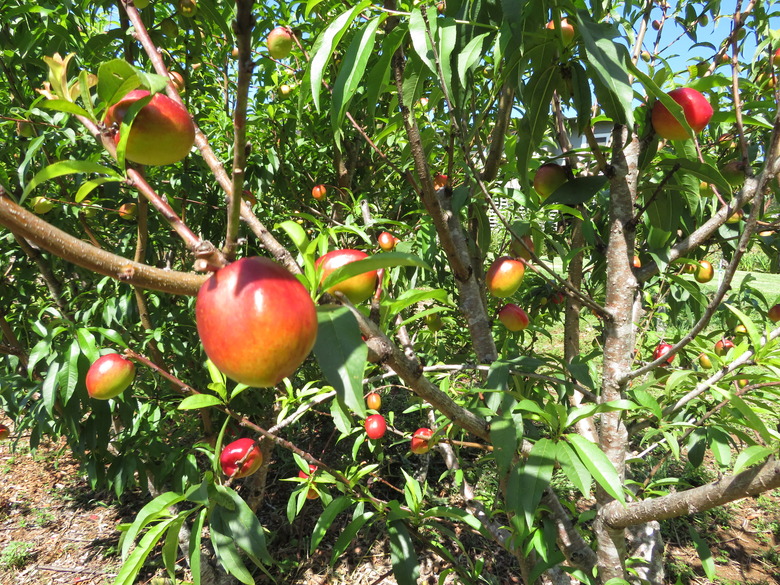
Nectarines (Prunus persica var. nucipersica) are a type of stone fruit closely related to peaches but with one significant difference: Nectarines lack fuzz on their skin.
In the home garden, these deciduous trees require plenty of care in order to produce a quality crop year after year. Nectarine trees are hardy in USDA plant hardiness zones 5 to 9.
Are Nectarines Self-Pollinating?
Nectarine trees are self-pollinating, or self-fertile. That means they can set fruit with their own pollen and do not need to be cross-pollinated by a different cultivar. In other words, you only need one nectarine fruit tree to harvest a crop.
However, planting multiple nectarine tree cultivars has an advantage. Because different cultivars produce fruit at different times, you can extend the growing season. Cross-pollination may also increase yields.
Tip
Because they are self-fruitful, only one nectarine tree is needed to produce fruit.
Nectarine Tree Planting
Before planting a nectarine tree in your garden, you'll want to select the appropriate site. Like most fruit trees, nectarine trees perform best in full sun.
Nectarine trees grow best in well-draining soil with a pH of 6.5. If you need to adjust the soil pH, do so at least a year before planting, but do not add fertilizer to the planting hole or fertilize the tree right after planting it. You should, however, water a newly planted tree thoroughly.
Plant nectarine trees at the same depth that they grew in their nursery containers.
 Forest and Kim Starr
Nectarine Tree Care
Nectarine trees require plenty of maintenance if you want to harvest homegrown fruit. Let's go over what the care of these trees entails.
Fertilizing
Nectarines benefit from fertilizer, especially nitrogen and potassium.
Nectarine trees do not produce fruit during the first two years of planting, so young trees require less fertilizing. Apply a balanced fertilizer in March during the trees' first and second years. Feed your young nectarine trees again in May and July with calcium nitrate. Avoid fertilizing nectarine trees too late in the summer, as this can make the trees more susceptible to cold temperatures.
Mature trees should be fertilized based on nutrient needs in March and May and after harvesting fruit.
Pruning
Nectarine trees should be pruned into what is known as an open-center system, which allows the maximum amount of sunlight to penetrate the tree. Peach trees also need to be pruned to remove diseased branches.
Thinning Fruit
Nectarine trees often produce an excessive amount of fruit, which can diminish the quality of the crops and also weigh down branches to the point that they break. Therefore, to harvest full-size nectarines and preserve the branches, you'll want to thin the fruit.
Tip
Nectarine trees produce more fruit than their branches can support. Thinning the fruit can prevent branches from breaking.
You should thin nectarines about four weeks after the flowers have bloomed to allow 6 inches of space between individual fruits.
Disease and Pest Control
Nectarine trees are susceptible to a number of diseases, including fungal diseases like peach leaf curl and brown rot. These can affect fruit production. Therefore, spraying fungicides is almost always necessary, typically with the goal of preventing diseases before they begin.
There are also several insect pests that target nectarine trees, including peach borers and the plum curculio, which means that insecticides are also needed.
One way to control both disease-causing pathogens and insect pests that attack nectarine trees is by removing fallen leaves and fruits around the tree in the fall, as many fungi and insect eggs and larvae can overwinter and continue to be a problem the following growing season.
References
- North Carolina State Extension: Prunus persica var. nucipersica
- Ohio State University Extension: Growing Peaches and Nectarines in the Home Landscape
- NatureHills: Popular Nectarine Trees Plus Planting, Pruning & Care
- Clemson Cooperative Extension: Peaches & Nectarines
- Clemson Cooperative Extension: Pruning Peaches & Nectarines
- Clemson Cooperative Extension: Peach Diseases
- Clemson Cooperative Extension: Peach Insect Pests
- Clemson Cooperative Extension: Fertilization of Peach Trees