

How To Keep A Venus Flytrap Alive
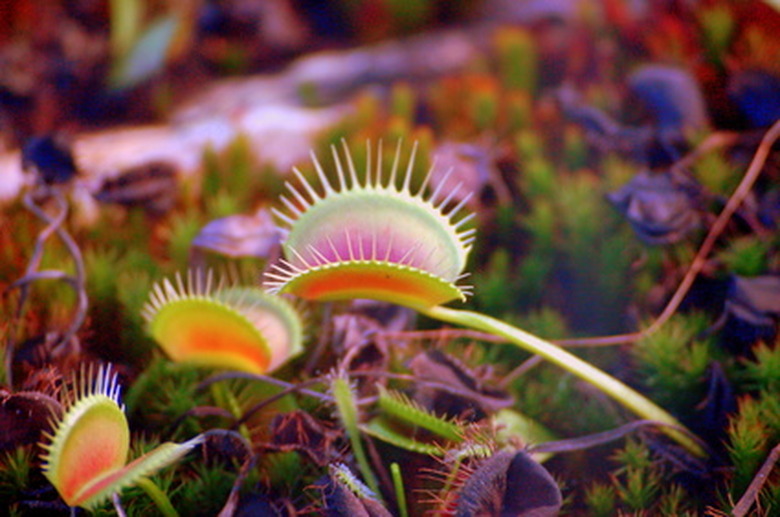
Native to the North Carolina coast and certain parts of South Carolina, the Venus flytrap is a fascinating carnivorous plant often grown indoors by hobbyists. The plant's odd-looking trap will snap shut on unsuspecting insects that have been lured by its sweet scent. Carnivorous plants have several very specific requirements, and while keeping a Venus flytrap alive isn't particularly easy, it can be done with a bit of dedication and patience.
Step 1
Choose an appropriate planting container for the Venus flytrap. Carnivorous plants require high humidity, and the best way to provide this is with a terrarium. Place 1 inch of sand or gravel in the bottom of the terrarium, and cover it with sphagnum moss. Both dried sphagnum moss and living sphagnum moss are available at garden centers, and either will work.
- Native to the North Carolina coast and certain parts of South Carolina, the Venus flytrap is a fascinating carnivorous plant often grown indoors by hobbyists.
- Carnivorous plants have several very specific requirements, and while keeping a Venus flytrap alive isn't particularly easy, it can be done with a bit of dedication and patience.
Step 2
Place a glass cover over the terrarium to maintain a humid environment, but leave the cover slightly ajar to allow air circulation. Place the terrarium where the daytime temperature will be between 70 and 75 degrees F.
Step 3
Put the terrarium where the Venus flytrap will be exposed to at least 14 hours of sunlight every day between May and the end of September. If necessary, place the terrarium under a grow light or fluorescent bulb.
Step 4
Keep the sphagnum moss wet at all times. Water the moss using distilled water or rainwater. Never use regular tap water, as the fluoride, chlorine and other chemicals will build up and eventually kill the Venus flytrap.
- Place a glass cover over the terrarium to maintain a humid environment, but leave the cover slightly ajar to allow air circulation.
- If necessary, place the terrarium under a grow light or fluorescent bulb.
Step 5
Feed the Venus flytrap one or two insects per week. If you feed the plant maggots, poke the maggot with a toothpick, as maggots can sometimes eat their way through the trap. Maggots can be purchased at stores that carry fish bait. Blood worms, available at pet stores, are also appropriate. Don't fertilize the Venus flytrap, and don't feed it meat or other human food.
Step 6
Move the terrarium into cooler temperature and lower light between October and the end of April, as Venus flytraps require a period of dormancy. Daytime temperatures should be between 55 and 60 degrees F. Gradually decrease the hours of light until the Venus flytrap is exposed to about eight hours of sunlight per day in January and February, then increase the amount of light back to normal levels by May. Keep the sphagnum moss moist during the winter months, but not soggy.
- Feed the Venus flytrap one or two insects per week.
- Daytime temperatures should be between 55 and 60 degrees F. Gradually decrease the hours of light until the Venus flytrap is exposed to about eight hours of sunlight per day in January and February, then increase the amount of light back to normal levels by May.
- Keep the sphagnum moss moist during the winter months, but not soggy.
Step 7
Remove the sphagnum moss from the terrarium every three to four years, and replace it with fresh moss, as sphagnum moss gradually shrinks.
Tip
If you don't have a terrarium, plant the Venus flytrap in a regular pot filled with sphagnum moss. Put the pot in a bowl with 2 to 3 inches of water. As the water in the bowl evaporates, it should be replenished. An old fish tank make a good, low-cost terrarium and will hold several Venus flytraps. If you want to feed your Venus flytrap flying insects, put the insect in a sealed jar and place the jar in the refrigerator until the insect turns sluggish. Use a pair of tweezers to place the insect carefully on the trap.
Warning
Never harvest Venus flytraps in the wild. Venus flytraps are endangered in many areas, and collecting the plants in this manner is illegal. Never feed a Venus flytrap an insect larger than a third the size of the trap.
Things Needed
- Terrarium with cover
- Sand or gravel
- Sphagnum moss
- Grow light or fluorescent bulb
- Distilled water or rainwater
- Insects