

Black-Eyed Susans
Step 1
Perennial black-eyed Susan (Rudbeckia fulgida) asks little of you once established. It cheerfully endures neglect while surviving quite nicely on whatever nature throws at it. These jaunty, daisy-like perennials can even withstand brutal winters up into the North American Great Lakes region. With just a little attention in the fall, your Susans will return to you for many springs to come.
Step 2
Step 1
Cut black-eyed Susans freely for arrangements from late July into the fall. Don't remove the spent flowers or any foliage following the last bloom flush of the season. The seeds are an excellent food source for birds during the winter.
- Perennial black-eyed Susan (Rudbeckia fulgida) asks little of you once established.
- Cut black-eyed Susans freely for arrangements from late July into the fall.
Step 2
Cut back black-eyed Susans in late fall when foliage has browned and the plants have gone completely dormant around mid-October. Leave stems about 3 to 4 inches taller than the basal leaves. This will help to trap snow during the winter, keeping the plants warm enough to survive.
Step 3
Divide large established plants every three or four years.
Step 4
Mulch black-eyed Susans well with several inches of dead leaves.
Step 5
Cut back and destroy any diseased plants in your garden. Don't add the vegetation to your compost heap.
- Cut back black-eyed Susans in late fall when foliage has browned and the plants have gone completely dormant around mid-October.
Thriving
Black-eyed Susans are not sensitive to varying ph levels in soil. They grow quickly and thrive in open woods, fields, and gardens.
Height & Width
These wildflowers have stalks that can grow quite tall, up to 8 inches long. Their flowers can bloom up to 3 inches across.
Competitive Flowers
As a competitive flower, black-eyed Susans can take over surrounding plants and flowers if left untamed.
Poor Resistence
These flowers have a poor resistance to deer and rabbits, and can easily become victim to their voracious appetites. They also attract bees, birds and butterflies.
- Black-eyed Susans are not sensitive to varying ph levels in soil.
Small Visitors
Black-eyed Susans serve as a home for black carpenter ants, leopard slugs, ticks, chiggers, goldenrod spiders and European starlings.
Germination
These flowers germinate between seven and 30 days and commonly bloom between late summer and early fall.
Description
Black-eyed Susan vines (Thunbergia alata) originated in tropical Africa. They grow 6 to 10 feet high and twine around their supports. The flowers are about 1 inch across and tubular shaped; leaves are triangular.
Varieties
Some varieties of yellow black-eyed Susan vines are Sunny Lemon Star and Canary Eyes. Orange varieties include Tiger Eyes and Susie; varieties of white black-eyed Susan vines include Angel Wing, Bright Eyes and Alba.
- Black-eyed Susans serve as a home for black carpenter ants, leopard slugs, ticks, chiggers, goldenrod spiders and European starlings.
- Orange varieties include Tiger Eyes and Susie; varieties of white black-eyed Susan vines include Angel Wing, Bright Eyes and Alba.
Uses
Train back-eyed Susan vines along a fence, over an arbor or on a trellis. You can also grow it as a ground cover, in a hanging basket or in a tall container.
Sowing Seeds
Sow seeds about 1/4 inch deep after the last frost. Water well and keep moist. Black-eyed Susan vine seeds germinate in 14 to 21 days.
Culture
Grow black-eyed Susan vines in moist, well-drained soil in full sun or partial shade. Apply fertilizer every 4 to 6 weeks, according to the manufacturer's directions.
- Train back-eyed Susan vines along a fence, over an arbor or on a trellis.
- Sow seeds about 1/4 inch deep after the last frost.
Description
Black-eyed Susans have bright yellow or gold flowers on 2- to 3-foot tall plants. They grow in zones 2 through 11. Black-eyed Susans are treated as annuals in colder zones and as short-lived perennials in warmer zones. They reseed easily.
Varieties
In addition to the native Black-eyed Susans, several varieties are available. Becky is an unusual plant because it has orange, yellow, russet and mahogany colored blooms all on one plant. Toto and Maya are dwarf varieties with yellow flowers that can be used in the front of a flower border. Cherokee Sunset has bright yellow double blooms. Prairie Sun and Irish Eyes have unusual flowers–yellow with light green centers.
- Black-eyed Susans have bright yellow or gold flowers on 2- to 3-foot tall plants.
- Becky is an unusual plant because it has orange, yellow, russet and mahogany colored blooms all on one plant.
Benefits
Black-eyed Susans are larval plants for Bordered Patch (Chlosyne lacinia) and Gorgone Checkerspot (Chlosyne gorgone) butterflies, so they are excellent plants for butterfly and wildflower gardens. They are grown as cutting plants and the flowers will last 6 to 10 days in a floral arrangement.
Pests and Diseases
Aphids suck sap from black-eyed Susans, while goldenglow sawflies may defoliate the entire plant. Four-lined plant bugs also attack black-eyed Susans. The plants are susceptible to wilt caused by downy mildew, as well as leaf spots. Powdery mildew and white smut are also problems on black-eyed Susans. Verticillium wilt causes the death of infected plants.
- Black-eyed Susans are larval plants for Bordered Patch (Chlosyne lacinia) and Gorgone Checkerspot (Chlosyne gorgone) butterflies, so they are excellent plants for butterfly and wildflower gardens.
- Aphids suck sap from black-eyed Susans, while goldenglow sawflies may defoliate the entire plant.
Fun Facts
"Black-eyed" actually refers to the brown domed center of the flower. The black-eyed Susan is the state flower of Maryland.
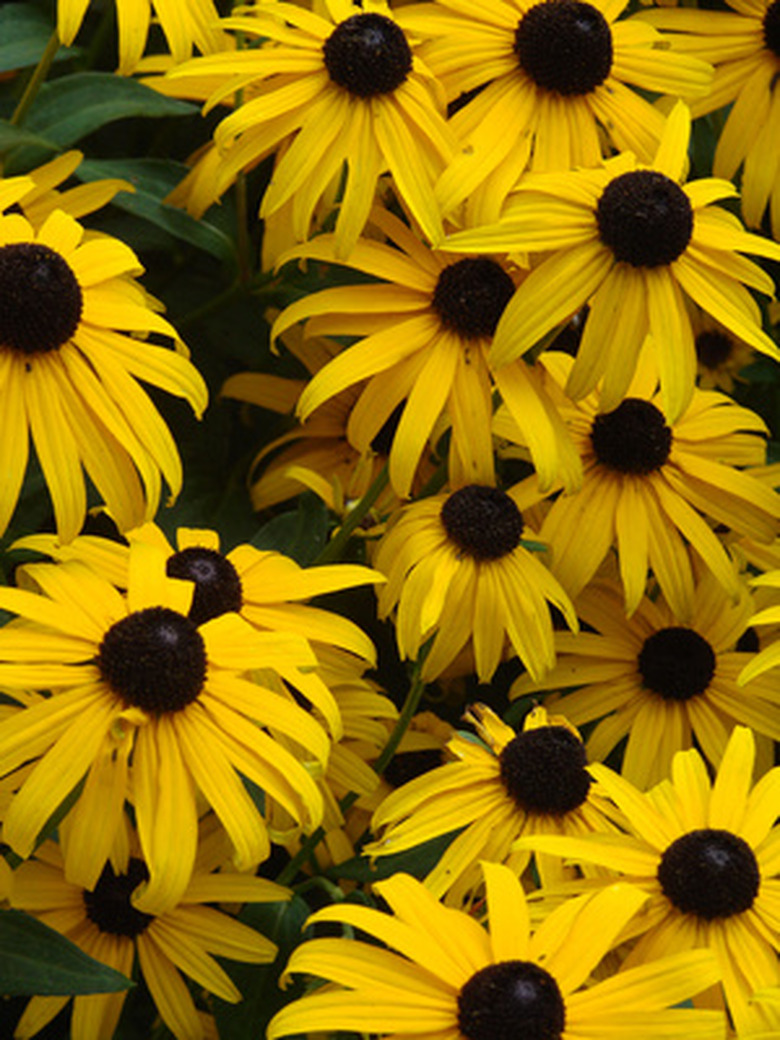
Black-Eyed Susan (Rudbeckia hirta) seeds germinate more successfully when started indoors. Rudbeckia seeds need well-draining soil, full sunlight and temperatures of 70 to 75 degrees Fahrenheit to bloom. Black-Eyed Susans take 5 to 10 days to sprout, under proper planting conditions.