

Flowering Bulbs In Arizona
Flowering bulbs in Arizona provide gardeners with a reliable source of color and interest; the root systems of bulbs act as food storage centers for the plants, allowing them to exist in dry conditions, such as the arid desert climate of Arizona, according to the Arizona Cooperative Extension. Some bulbs are particularly well suited to Arizona.
Tulips
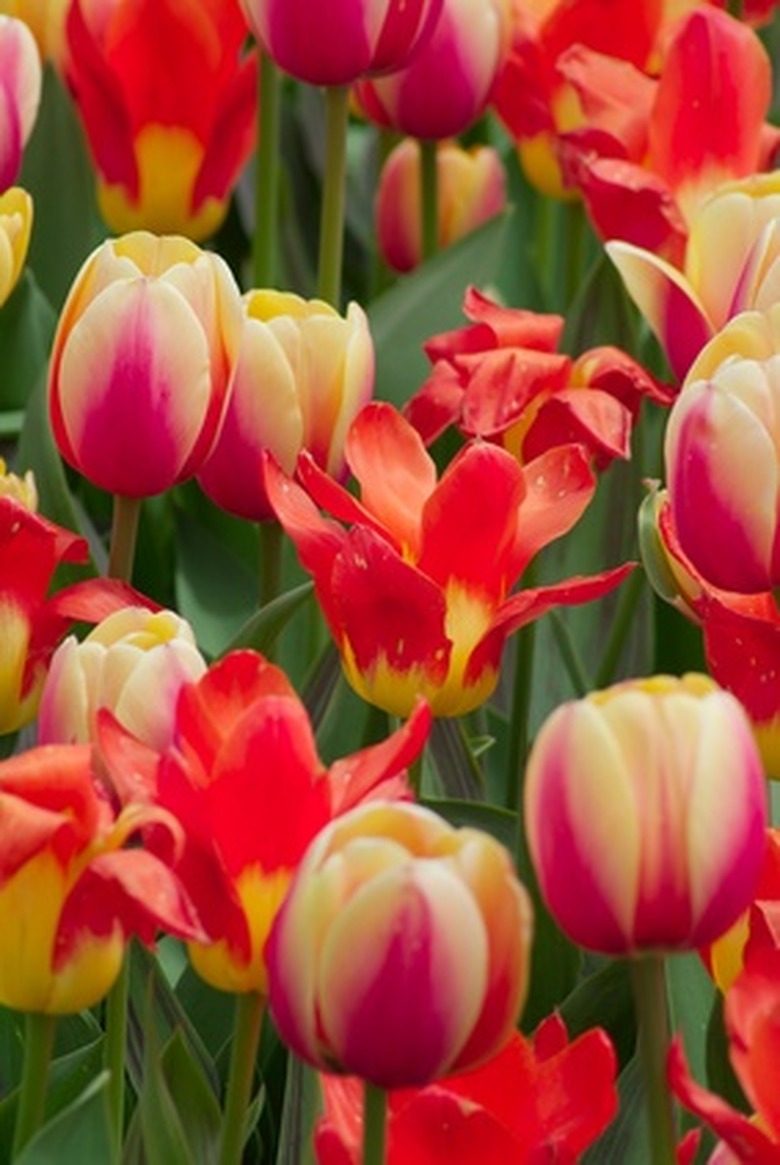
Tulips (Tulipa spp. and hybrids) are hardy flowering bulbs well suited to Arizona and display blooms in every color of the spectrum except for blue. Tulips thrive in full sun, prefer well-drained soil and grow to a height of 3 to 30 inches, according to the Purdue University Cooperative Extension Service. Bloom time for tulips is during the spring season.
Hyacinth
Hyacinth (Hyacinthus orientalis), also referred to as common hyacinth and Dutch hyacinth, are hardy flowering bulbs that display blooms in white, blue, purple, red, yellow, and varieties of pink. Hyacinths thrive in full sun, prefer well-drained sandy loam soil and grow to a height of 6 to 15 inches, according to the Purdue University Cooperative Extension Service. Bloom time for hyacinth bulbs is during the spring season.
- Flowering bulbs in Arizona provide gardeners with a reliable source of color and interest; the root systems of bulbs act as food storage centers for the plants, allowing them to exist in dry conditions, such as the arid desert climate of Arizona, according to the Arizona Cooperative Extension.
- Hyacinths thrive in full sun, prefer well-drained sandy loam soil and grow to a height of 6 to 15 inches, according to the Purdue University Cooperative Extension Service.
Crocus
Crocus plants (Crocus spp. and hybrids) are hardy flowering bulbs appropriate for Arizona that display blooms in purple hues (solid or striped), white, blue or yellow. Crocus bulbs thrive in full sun to partial shade, prefer moist, well-drained soil and grow to a height of 2 to 6 inches, according to the Purdue University Cooperative Extension Service. Bloom time for crocus bulbs is early in the spring season (though a few species bloom in autumn).
Narcissus
Narcissus (Narcissus spp. & hybrids) is a hardy flowering bulb appropriate for Arizona that displays blooms in white, yellow, orange, red or pink. Narcissus bulbs thrive in full sun to light shade, prefer well-drained soil and grow to a height of 3 to 14 inches, according to the Purdue University Cooperative Extension Service. Bloom time for narcissus bulbs is early to mid spring.
- Crocus plants (Crocus spp.
- Narcissus bulbs thrive in full sun to light shade, prefer well-drained soil and grow to a height of 3 to 14 inches, according to the Purdue University Cooperative Extension Service.