

Wisteria
Step 1
Wisteria is an aggressive, climbing and twisting vine that grows best in full sun. In fact, if a wisteria vine is not in full sun, it may not bloom at all. However, this sun exposure may lead to watering concerns. Special care after planting, along with some watering techniques, will help your wisteria thrive.
Step 1
Mulch over wisteria roots. Use a couple inches of mulch, such as wood chips, pine needles or bark, and cover about a two foot perimeter around the base of the plant. Mulch will help retain water and maintain soil temperatures.
- Wisteria is an aggressive, climbing and twisting vine that grows best in full sun.
- Special care after planting, along with some watering techniques, will help your wisteria thrive.
Step 2
Water a wisteria vine in the morning or evening on hot summer days, which will maximize water retention by reducing evaporation. Water slowly and only as fast as the soil can absorb it. Be sure to cover the entire root system, which can spread out a couple feet from the base of the plant depending on the age of your vine.
Step 3
Soak the soil with a few inches of water right after planting a wisteria vine.
Step 4
Water a newly plant wisteria vine an inch of water each week provided it did not rain at least an inch of water that week. Keep this up for the first few months until the vine is well established.
Step 5
Water an established wisteria vine sparingly. It generally does not need any other water other than rainfall; however if your area is experiencing a drought, then water it about an inch every two to three weeks.
- Water a wisteria vine in the morning or evening on hot summer days, which will maximize water retention by reducing evaporation.
- It generally does not need any other water other than rainfall; however if your area is experiencing a drought, then water it about an inch every two to three weeks.
Form
Wisteria has a compound leaf, which is made up of the central stem with 13 to 19 lance-shaped leaflets.
Structure
Leaflets are positioned opposite each other along the stem with a single leaflet at the end. Leaflet pairs are spaced evenly along the stem between 1 and 2 inches apart.
Size
Each leaf is 10 to 15 inches long. Each leaflet is approximately 1 1/2 to 3 inches long and 1/2 to 1 inch wide.
Color
The color of the leaf is light to bright green during the growing season and merging leaves may be tinged with red. The leaves may turn yellow in autumn before falling.
- Wisteria has a compound leaf, which is made up of the central stem with 13 to 19 lance-shaped leaflets.
Texture
Mature leaves are smooth on the top and bottom surfaces. Young leaves may have a silky texture.
Step 1
Cut back the wisteria growth to the stump by removing the limbs and branches of the vine with pruning shears or a saw.
Step 2
Combine 1 cup glyphosate or triclopyr herbicide with 3 cups water in a bucket to produce a 25 percent solution of herbicide.
Step 3
Dip a sponge into the herbicide solution and rub it directly on the cut surface of the wisteria stump to kill the root system of the plant.
Step 4
Dig the root system of the wisteria out of the ground using a shovel after the stump begins to die from the application of herbicide.
Step 1
Select a well-draining site in full sun for your wisteria. These plants require at least six hours of direct sunlight each day. They prefer moist locations that don't dry out excessively, but won't tolerate wet feet. Multiple plants will need at least 10 to 15 feet of space between them.
- Mature leaves are smooth on the top and bottom surfaces.
- Dip a sponge into the herbicide solution and rub it directly on the cut surface of the wisteria stump to kill the root system of the plant.
Step 2
Test the soil for pH and phosphorus levels. Wisteria prefer neutral to somewhat acidic soil with a pH range of about 6.0 to 7.0. Make needed changes while you're preparing the soil.
Step 3
Prepare a 3-foot diameter area for the wisteria plant. Cultivate the soil to a depth of at least 18 to 24 inches. Improve the aeration and drainage properties by mixing in compost, peat moss or well-rotted manure. The organic material should comprise about 1/3 of the cultivated area's soil.
- Test the soil for pH and phosphorus levels.
- Improve the aeration and drainage properties by mixing in compost, peat moss or well-rotted manure.
Step 4
Adjust the site's pH level if necessary. If it's too high, apply aluminum sulphate or sulfur. If the pH tests too high, use garden lime. Follow the packaging instructions carefully.
Step 5
Apply a super phosphate 0-20-0 fertilizer to the area if your soil test results indicate that the phosphorus level is low. Phosphorus is crucial for the development and production of blooms, fruits and seeds. Follow the manufacturer's recommendations carefully.
- Adjust the site's pH level if necessary.
- Apply a super phosphate 0-20-0 fertilizer to the area if your soil test results indicate that the phosphorus level is low.
Things Needed
- Soil test kit
- Organic material: compost, peat moss or well-rotted manure
- Aluminum sulphate or sulfur
- Garden lime
- Phosphate 0-20-0 fertilizer
Step 1
Provide your wisteria tree with at least six full hours of sunshine a day.
Step 2
Water a newly-planted wisteria tree several times a week for the first year. After that, water the wisteria tree to keep the soil moist, but not soggy. The tree will require more water during dry periods.
Step 3
Apply a 5-10-20 fertilizer once in the early spring. Wisteria do not need a lot of fertilizer, and may not bloom if given too much.
Step 4
Prune your wisteria tree in the fall. Remove most of each branch, leaving a 6-inch length. Wisteria can withstand a hard pruning, so don't be afraid to cut it back.
- Provide your wisteria tree with at least six full hours of sunshine a day.
- Wisteria do not need a lot of fertilizer, and may not bloom if given too much.
Step 5
Support the tree by placing a sturdy stake 1/2 inch away from the trunk and 12 inches into the ground. Secure the tree to the stake using either a flexible tape or the legs from an old pair of panty hose. Use a tie material that won't cut into the flesh of the tree as it grows.
Things Needed
- Fertilizer
- Stake
- Flexible tie material
- Garden pruners
Step 1
Place wisteria cutting in rooting hormone, and coat the end well. Put the cutting into a bucket of water, roots should form in 2 to 3 weeks. Prepare soil by adding peat moss and compost to improve nutrient content and increase aeration.
Step 2
Use a post hole digger to make a hole one foot deep. Place the trellis in the hole at a slight angle, and pack the soil around it tightly. Dig another hole opposite the first one and place another trellis angled towards the first one. The trellis will support each other as the wisteria matures and become heavy.
- Support the tree by placing a sturdy stake 1/2 inch away from the trunk and 12 inches into the ground.
Step 3
Dig a small hole in the soil approximately six inches down, and place the root ball in the hole. Cover with soil 2 to 3 inches up the stem. Water thoroughly, soaking the soil. Wisteria requires heavy watering once per week.

Step 1
Prune each of the limbs of the wisteria tree in the summer months to help maintain its size and shape. Pick up the end of each limb and trace it back until you locate the fullest portion of leaves. Cut the limb at this location using pruning shears.
Step 2
- Dig a small hole in the soil approximately six inches down, and place the root ball in the hole.
- Cut the limb at this location using pruning shears.
Step 3
Wait until just before the first frost in the fall. Count six shoots from the very top of each limb and cut off the remainder with pruning shears.
Step 4
Examine the limbs closely for discoloration due to disease and for those that failed to bloom the prior spring. Cut off these limbs 1/2 inch above where they join the main tree trunk using the pruning shears.
Step 5
Look for any limbs that are rubbing against another limb or growing towards the tree trunk rather than outward. Remove these limbs with the pruning shears to prevent them from scraping the tree bark off, and to open the interior of the tree to more light.
Step 6
Prune the remaining limbs into the desired shape, such as an umbrella pattern. Concentrate only on the shape of the limbs and not the foliage since the leaves will all die off in the winter.
Step 7
- Wait until just before the first frost in the fall.
- Remove these limbs with the pruning shears to prevent them from scraping the tree bark off, and to open the interior of the tree to more light.
Scientific Name
Scarlet wisteria's scientific name is Sesbania punicea. It is a member of the Fabaceae family.
Geography
Scarlet wisteria prefers to grow in warm weather. It will grow well outdoors in zones 9 and above. Scarlet wisteria will grow in zone 8, if protected from the cold.
Size
Scarlet wisteria can reach a height of 12 feet tall when grown in prime conditions. It averages in height from six to 10 feet.
- Scarlet wisteria's scientific name is Sesbania punicea.
- Scarlet wisteria can reach a height of 12 feet tall when grown in prime conditions.
Flowers
The flowers of scarlet wisteria are orange-red in color and grouped into clusters that are four inches long. The flowers bloom in late spring through summer.
Seeds
The seedpods on scarlet wisteria are three to six inches long and resemble pea-plant seedpods. There are usually six to 10 seeds in each pod.
Problems
Scarlet wisteria is an invasive plant in some states. It is an aggressive grower that will choke out native plant species.
Native Range
American wisteria is native to moist areas along creeks and boggy areas in the South Eastern U.S. from central Florida to Virgina to Texas. It often climbs over bushes, trees and fences for support.
- The flowers of scarlet wisteria are orange-red in color and grouped into clusters that are four inches long.
- The seedpods on scarlet wisteria are three to six inches long and resemble pea-plant seedpods.
Care
It likes full sun to partial shade with a rich moist but well draining soil. An established plant needs very little care.
Uses
With selective trimming, it can be trained into a single trunk tree. It readily grows up trellises and along rock walls.
Chinese Wisteria
American Wisteria is often chosen over the more common Chinese Wisteria because it is easier to control and tends to not smother out other trees and shrubs. The flowers of American Wisteria are slightly smaller
Flowering
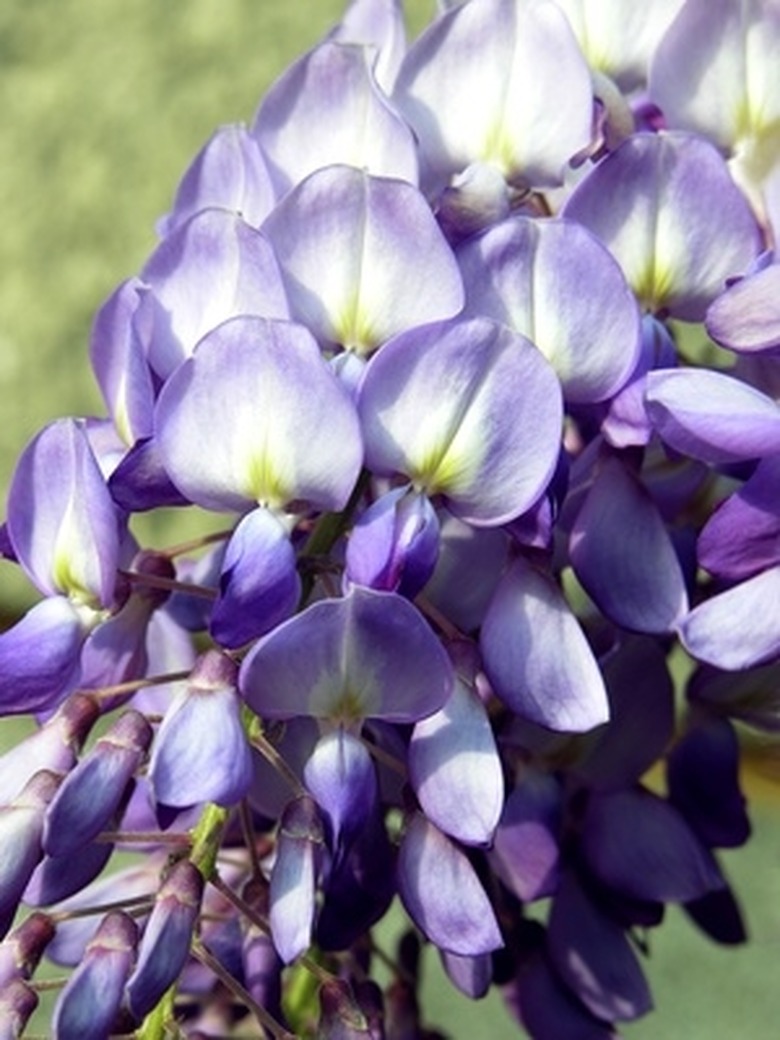
Flowers are usually purple, but dark purple, pink and white cultivars have been developed. Blooming is in late spring to early summer but can continue and be sporadic after July.
- It likes full sun to partial shade with a rich moist but well draining soil.
- With selective trimming, it can be trained into a single trunk tree.
Step 1
Tie new shoots to a fence, frame or against a tree trunk to fill in any gaps in the leaves during the month of August. Cut the current limbs approximately 1 foot to restrict growth and produce more flower buds.
Step 2
Prune again in February to shorten the limbs approximately 1 to 2 inches. Cut at a 45-degree angle just above a flower bud. The buds look like knots in the limb.
Step 3
Train young plants by inserting a 4-to-5 foot support pole in the ground next to the plant. Allow the plant to grow until it reaches the top of the support. In February, cut the tip so that the main trunk will produce side stems. In August, prune again as you would for an existing wisteria.
- Tie new shoots to a fence, frame or against a tree trunk to fill in any gaps in the leaves during the month of August.
- In February, cut the tip so that the main trunk will produce side stems.
Step 4
Cut any old, dead trunks just above healthy, green side limbs. This will cause the base of the wisteria to continue growing through the cut you made, and the plant will fill out. Note that if your wisteria has to be severely pruned, it will take approximately three years for flowering to begin again.