Copyright © 1997-2010 Demand Media. All rights reserved.
by Naomi Mathews (Lanao2(at)aol.com)
Copyright 2003 by Naomi Mathews
Sometimes I get the yen NOT to get down on hands and knees to plant things in my flower garden. Ever feel that way? If so, please come along with me for a while. Id like to show you how Im going to create some great moss-filled hanging baskets come early spring.
I have always enjoyed planting a variety of colorful flowers in hanging baskets (and Ive had some beauties!). Watching them as they grow, spread, and finally fill out the entire basket, then trail way over the edge is more than rewarding. PLUS, I get to enjoy standing upright while planting them! Thats always a nice change from crawling along on hands and knees, dragging along a tray or two of small potted annuals, my knee pads, a water hose, and my gardening tools. Not that I dont enjoy that type of planting too--I do! But planting in containers seems a lot easier when my knees get creaky and my back starts to feel like its been run over by a Mac truck!
Now, if you have a potting shed--which I dont--youre among the more blessed gardeners of the world. If you dont, never fear! All you really need to work on while creating and planting moss hanging baskets is a table of some sort. If your best patio table is your only available planting surface, drape it with a sheet of painters plastic, an old tablecloth, or even an old faded sheet to protect it from the soil, fertilizer, and moss. Preparing and planting moss wire baskets can be a muddy adventure, no matter how carefully you start out. An old wooden picnic table will serve well too. Or, drag out your card table, set it up in a nice shady spot--perhaps under your favorite shade tree--and away you go!
Yes! Im in the mood to begin thinking about creating my moss baskets. This year, Im going to plant flowers in them to attract both hummingbirds and butterflies to my deck and patio all summer. Where I live (Washington State USDA Zone 6) its still much too early to think of planting anything outdoors. But, it isnt too early to start planning. Perusing your favorite garden center for the few items youll need to create colorful, fragrant, eye-catching moss baskets can be a wonderful winter gardening activity. Better yet, it just may keep you from suffering from the nasty winter doldrums.
Over the years, Ive used many types of wooden baskets, but have found they tend to rot easily over a season or two. There are also a wide variety of plastic hanging pots available. Theyre okay too, but not my favorites. So, this year Im going for some lovely moss-filled wire baskets again. Those are my all-time favorites, even though they do require a bit more effort. When finished and in full bloom, they are delightful!
Items you will need to create moss-filled wire hanging baskets
The perfect hummingbird habitat is a simple one, and even the smallest garden can provide the food, water, perches, shelter and nesting sites that hummingbirds need. With Dale Gelfand's advice and easy-to-follow instructions you'll soon lure these beautiful birds into your backyard -- and keep them coming back year after year.
Preparing the wire basket
Outlined below are the plants I will choose for my baskets. Several are hummingbird and/or butterfly attractants containing nectar. I will also choose a foliage plant for color contrast.
Ivy Geranium: Choose geraniums in a color that either compliments or contrasts the other colors in your basket. The Ivy Geranium trails nicely, producing bright green shiny, ivy-shaped leaves. For my basket, I'll choose a combination of red and pink ones. Ivy geraniums are very vigorous and bloom all summer. They will attract many a butterfly, as butterflies prefer landing on single-petal blossoms.
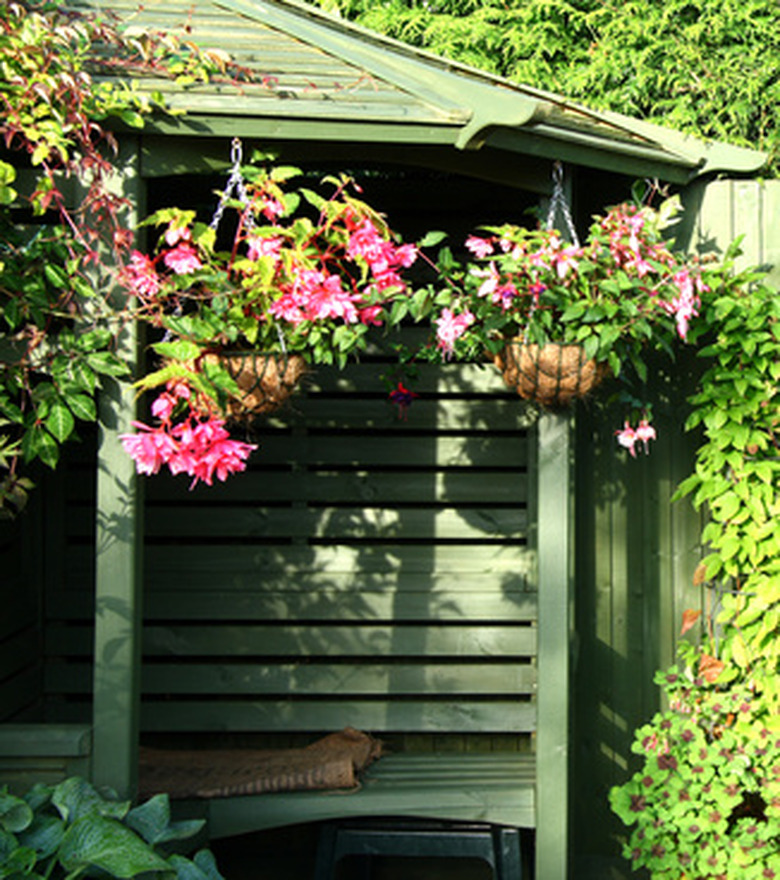
Fuchsia: There are so many dazzling varieties of fuchsias one could get confused. Since I want to attract both jewels of the sky and flying flowers I'll plant a brightly colored fuchsia, such as the Black Prince. Fuchsias have no fragrance, but hummers are greatly attracted to them because of their brilliant colors. The "magellanica" produces many long, drooping stems that become heavily loaded with red and violet flowers lasting from July through frost. Fuchsias are glorious in hanging baskets and have always been a favorite. They require an abundance of water throughout their growing season, especially in warmer climates. Also, they prefer more shade than sun in hot zones such as mine.
Trailing Lobelia: The lobelia is such a versatile little plant! I love it most anywhere in my garden. Since I also want something blue and white in my basket, I love the Blue Cascade and White Lady. Both come in the trailing variety just made for hanging baskets. There are also other colors such as carmine red, purple with white eyes, and Cambridge blue. Lobelia is quite hardy, and thrives in our summer heat. It blooms into late fall and requires little care. Its blossoms are very showy indeed and are used widely for container planting. To see just how lovely lobelia looks in hanging baskets, take a little side trip to Meadowview for a while and feast your eyes on some gorgeous hanging baskets filled with lobelia.
Pink Sand Verbena: This variety of verbena grows upright, and has massed heads of small round-topped flowers. They bloom in clusters about 2 inches across, having tiny 1/2 inch blossoms. Verbena comes in a rainbow of bright colors, and will attract both hummers and butterflies. It is also a very showy plant that adds vivid color to hanging baskets. Verbena are actually perennials to the West Coast, but are used widely as annuals in colder climates.
Lotus: I will add just a few lotus (L.bertholetii, parrots beak, coral gem) as a final touch. The lotus is a trailing plant, having lush grayish-green fluffy leaves. Its branches grow and spread nicely, and the color contrast with the other greens is very eye-catching. It has tiny flowers shaped rather like a birds beak. Ive used lotus for many years with success in my baskets--its totally carefree! Lotus also loves our long, hot summers.
Planting Guidelines
Begin by planting the Ivy Geranium from the inside of the basket, carefully poking its tender leaves through the moss and wire. This leaves the roots with their soil toward the inside of the basket. Space them to leave enough room between each plant for the fuchsias, which will be planted next. Tap the soil gently around each plant so it stays in place.
Next, plant the fuchsias in the spaces between the geraniums, again poking the leaves through the moss and wire. Planting the fuchsias between the geraniums lends great foliage contrast to your basket. Since fuchsias become very full and spread a great deal, they will need adequate space of their own so as not to crowd the geraniums. Both plants need trailing and spreading room.
At this point, fill in any small spaces left around the outer edges of your basket with the lobelia, alternating colors. Again, plant from the inside of the basket, carefully pushing the leaves through moss and wire. Loosen the soil a bit on the roots of each bunch of lobelia as this will give them a better start. Then cover the roots with potting soil. Lobelia can be planted quite close together and will do well.
Plant the Pink Sand Verbena in the top center of your basket, since it grows upright to about 6-8 inches. Ive not used verbena in hanging baskets yet, but am going to give them a whirl this spring. They are known as perennials but are also used as annuals, especially in hot climates.
Lastly, I'll plant a few trailing lotus (IF I have any space left!) around the top edges of my basket. They dont take up much space, and wont interfere with the geraniums or fuchsias. Just a nice contrast of texture and color! Fill in any areas that need more soil. As a last touch, I usually turn my water hose to a fine mist and give all my new plants a nice clean shower. There--it's ready to hang!
Care tips for your Heavenly Hanging Hummer Basket
Now, sit back--enjoy your handiwork--and let Mother Nature take care of the rest!
Originally published on the Internet at Suite 101 in the "Gardening" area.
GardenGuides.com
Forsythia In Bloom
Zone 5 | Blooming
More Raised Beds
Zone 7 | Planting
First Snow
Zone 4 | Caring
GROWING VEGETABLES
Zone 8 | Harvesting
Filling Raised Beds Getting Th…
Zone 3 | Caring