

Yellow Leaves On My Roses - Part 1
by Mark Whitelaw (Part 2 – Part 3)
This time of year I receive a great deal of mail from gardeners asking why their rose's leaves are turning yellow. With little or no more information than this color description, the possibilities of a correct diagnosis are slim. Leaf yellowing is symptomatic of a variety of problems, most of which can be pigeon-holed into four main categories — enviro-mechanical problems, nutrient deficiencies, pest damage, and disease damage.
Enviro-mechanical problems Heat Stress
As temperatures warm during the summer, heat stress is a major cause for yellowing leaves. This type of stress is frequently noticed after wet and relatively cool spring weather, especially when the transition from spring to summer temperatures is sudden. Cool weather promotes tender new growth. Exposure of this new growth to direct sun can cause scorching of leaf margins.
- by Mark Whitelaw (Part 2 – Part 3) This time of year I receive a great deal of mail from gardeners asking why their rose's leaves are turning yellow.
- This type of stress is frequently noticed after wet and relatively cool spring weather, especially when the transition from spring to summer temperatures is sudden.
This type of stress is particularly noticeable on new roses – plants which have had insufficient time to establish root systems for supporting leaf transpiration during hot weather. During periods of high temperatures, low humidity and rapid air circulation around leaf surfaces, water demand by the plant is most critical.
Other symptoms to look for:
- Mechanical problems Often, in our zeal to nurture our roses, we may cultivate a bit too close to roots.
- This can sometimes happen without our knowing about it, especially if the roots are brought to the surface but are not quite exposed above mulch layers.
- "Bull nosed" blooms, especially on dark colored roses.
- Scorching of leaf margins.
- Dark petal edges on blooms (on dark colored roses).
Treatments:
- This type of stress is particularly noticeable on new roses – plants which have had insufficient time to establish root systems for supporting leaf transpiration during hot weather.
- Apply anti-transpirants/anti-desiccants (like Cloud Cover or WiltPruf).
Provide sun screens for new plants. - Plant roses where they will receive protection from the hot afternoon sun.
- Mulch heavily around root zones to stabilize soil and near-surface air temperatures.
- For new roses, concentrate on root development during their first year.
- Irrigate from above the rose during the hottest period of the day to reduce air temperatures. May cause other problems, however.
- * Apply anti-transpirants/anti-desiccants (like Cloud Cover or WiltPruf).
- Mulch heavily around root zones to stabilize soil and near-surface air temperatures.
- *
Water stress
Yellowing leaves may also occur as a result of excessive irrigation, too much rain or improper drainage. Water displaces air in the soil. As a result, roots cannot support the rapid transpiration required during hot summers.
Conversely, if too little water is applied, a drought condition exists. This can cause equally devastating results.
Other symptoms to look for:
- Mechanical problems Often, in our zeal to nurture our roses, we may cultivate a bit too close to roots.
- This can sometimes happen without our knowing about it, especially if the roots are brought to the surface but are not quite exposed above mulch layers.
- "Balling" blooms – the failure of blooms to open completely (excessive water conditions).
- "Pithy" cane centers – cane centers may appear soft and brown (excessive water conditions).
- Drooping mature leaves.
- Scorched leaf margins and tips on new growth (drought conditions)
Treatments:
- This type of stress is particularly noticeable on new roses – plants which have had insufficient time to establish root systems for supporting leaf transpiration during hot weather.
- Improve drainage.
- Reduce irrigation schedule in excessive water conditions.
- Increase irrigation schedule in drought conditions.
- * "Balling" blooms – the failure of blooms to open completely (excessive water conditions).
- * Scorched leaf margins and tips on new growth (drought conditions) Treatments: * Improve drainage.
- *
Salt stress
Rosarians who apply excessive amounts of water-soluble fertilizers to their roses frequently develop soil salt stress, especially in locations where soils tend to be heavy and/or where irrigation or rainfall fail to leach these salts beyond the root zone. Fertilizers containing high amounts of nitrate of soda, muriate of potash, potassium nitrate and ammonium nitrate can cause the highest accumulated salts. As the accumulation of salts builds in the soil, it competes with rose roots for moisture – essentially creating a drought condition for the rose. The result is yellowed leaves and eventually plant death. It is particularly critical with roses planted in containers.
Rain water and some water supplies can also contain dissolved salt ions in some locations. Common among these are bicarbonates, calcium, chlorides, fluorides, magnesium and sulfates – all of which can cause salt stress if found in excessive amounts. The chief culprit for causing salt stress among these is the chlorides.
- Salt stress Rosarians who apply excessive amounts of water-soluble fertilizers to their roses frequently develop soil salt stress, especially in locations where soils tend to be heavy and/or where irrigation or rainfall fail to leach these salts beyond the root zone.
- Fertilizers containing high amounts of nitrate of soda, muriate of potash, potassium nitrate and ammonium nitrate can cause the highest accumulated salts.
Other symptoms to look for:
- Mechanical problems Often, in our zeal to nurture our roses, we may cultivate a bit too close to roots.
- This can sometimes happen without our knowing about it, especially if the roots are brought to the surface but are not quite exposed above mulch layers.
- Reduced plant growth.
- Scorched leaf margins.
Treatments:
- This type of stress is particularly noticeable on new roses – plants which have had insufficient time to establish root systems for supporting leaf transpiration during hot weather.
- Irrigate deeply (where drainage is good) to leach accumulated salts from the root zone.
- If drainage is unsatisfactory, consider addng gypsum before leaching.
- If using synthetic fertilizers with a high "salt index," apply per label directions, or use smaller amounts on a more frequent basis.
- If using organic soil amendments (like manure), watch for high salt concentrations.
- Use organic fertilizers with a low "salt index."
- Perform regular soil tests to determine toxic levels of accumulated aluminum, ammonium nitrates and chlorides.
- For containered roses, flush potting soils frequently. Change out the soil every three to four years.
- Other symptoms to look for: * Reduced plant growth.
- * If using organic soil amendments (like manure), watch for high salt concentrations.
- *
Phytotoxicity
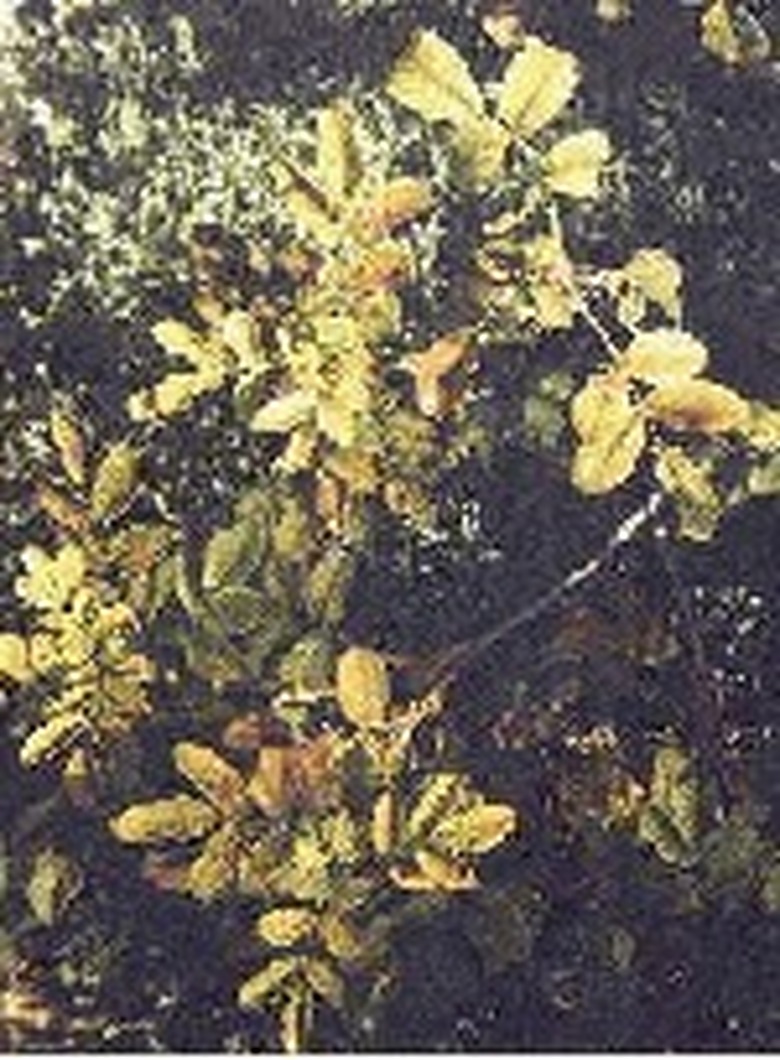
Chief among reasons for yellowing leaves is "suffocation" caused by spraying. When chemicals and/or their surfactants clog leaf pores (the "stomata"), plant tissues cannot transpire moisture and essential gasses, they cease producing chlorophyll, cell walls deteriorate, and the leaves yellow and eventually fall from the plant. This symptom will be readily apparent, usually within a few days of the chemical's application.
Further, some roses are, by their nature, less tolerant of spraying than others. Rugosas and their near "cousins" – roses with textured leaf surfaces – seem to be the most affected.
Still another form of phytotoxicity is caused by drift from nearby herbicide applications. Many herbicides contain surfactants which make them highly volatile and able to drift several hundred feet from their intended target.
- Phytotoxicity Chief among reasons for yellowing leaves is "suffocation" caused by spraying.
- Further, some roses are, by their nature, less tolerant of spraying than others.
Other symptoms to look for:
- Mechanical problems Often, in our zeal to nurture our roses, we may cultivate a bit too close to roots.
- This can sometimes happen without our knowing about it, especially if the roots are brought to the surface but are not quite exposed above mulch layers.
- Brown or scorched leaf margins.
- If caused by herbicide drift, dead growth tips on apical stems.
- Leaves will fall from the plant within a few days.
Treatments:
- This type of stress is particularly noticeable on new roses – plants which have had insufficient time to establish root systems for supporting leaf transpiration during hot weather.
- Avoid spraying chemicals with high viscosity ingredients (such as oils, whether natural or synthetic) or surfactants during the heat of summer.
- If spraying is necessary, do so very early in the morning.
- When working with a chemical new to you, always test a small, out of sight area of the plant first to determine if phytotoxicity will occur.
- If applying herbicides nearby, do so per label directions and on days when air movement is at its lowest. Use application techniques that permit direct contact with the pest weed, such as wands or paint brushes.
- Select roses that do not require excessive chemical treatments.
- Other symptoms to look for: * Brown or scorched leaf margins.
- * When working with a chemical new to you, always test a small, out of sight area of the plant first to determine if phytotoxicity will occur.
- *
Mechanical problems
Often, in our zeal to nurture our roses, we may cultivate a bit too close to roots. This can occur during routine weed removal, incorporation of fertilizers or soil amendments, or in our day to day soil cultivation operations. This can sometimes happen without our knowing about it, especially if the roots are brought to the surface but are not quite exposed above mulch layers. Of particular concern are roses grafted onto R. fortuniana root stocks – stocks with notoriously shallow root zones.
Damaging roots and destroying their associated micorrhizal fungi is essentially inducing a water and/or nutrient stress situation to the rose, thereby causing yellow leaves.
Other symptoms to look for:
- Mechanical problems Often, in our zeal to nurture our roses, we may cultivate a bit too close to roots.
- This can sometimes happen without our knowing about it, especially if the roots are brought to the surface but are not quite exposed above mulch layers.
- See heat and water stress symptoms.
- Check for roots coming out of the soil but below mulch layers.
Treatments:
- This type of stress is particularly noticeable on new roses – plants which have had insufficient time to establish root systems for supporting leaf transpiration during hot weather.
- Use caution cultivating in and around root zones.
- If roots are exposed, trim away broken sections and replant immediately.
- Irrigate deeply so roots will penetrate below normal cultivation zones.
- * See heat and water stress symptoms.
- *
Treatments: * Use caution cultivating in and around root zones. - *