

Facts About The Gumball Tree
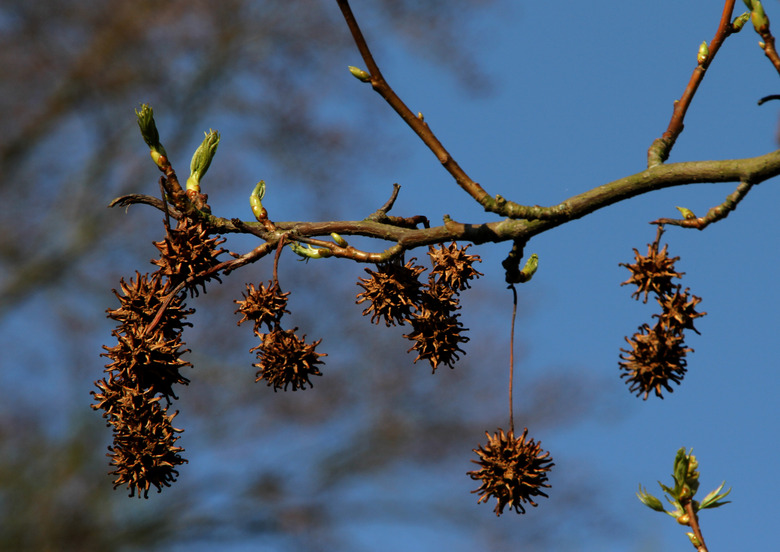
Also called the American sweetgum tree, the gumball tree (Liquidambar styraciflua) is a native tree. Gumball describes the round fruits, and sweetgum describes the fragrant resin that oozes from bark wounds.
Although it would be a botanical phenomenon if sweet and chewy gumballs grew on a tree, that's not what gives the "gumball tree" one of its common names. More commonly called American sweetgum tree, Liquidambar styraciflua is the North American native species in this genus, with its native habitat originating in the Eastern United States and Mexico.
It's a member of the Altingiaceae plant family, formerly classified in the Hamamelidaceae family, and a perennial in USDA plant hardiness zones 5 through 9, where it litters landscapes with its spiky round fruits called "gumballs" (from sweet "gum").
Tip
Numerous outstanding characteristics of this tree override its landscape litter problem, but plant breeding has produced a fruitless cultivar for gardeners who don't want to walk on ankle-twisting gumballs.
Gumball Tree Name
The common name "sweetgum" refers to the aromatic gummy resin that exudes from wounds on the tree. In times past, this sticky substance was used as a precursor to our modern-day chewing gum, although the word "gumball" refers to the tree's spherical fruits. The Gumball cultivar of the species, Liquidambar styraciflua 'Gumball,' is so-named not only because of the familiar round fruits but also because of its shape. It's a dwarf version of the species that grows only 6 feet tall and wide with a perfectly rounded shape.
 Victor Kravchenko
Gumball Tree Characteristics
Sweetgum trees aren't suitable for all locations, but they're stellar landscape specimens in the right spots. A full sun to partial shade site that can accommodate a mature potential height up to 120 feet, away from walkways where the sweetgum balls litter the ground and hardscapes, and where roots may buckle sidewalks and damage driveways, is best for sweetgum.
Size
Sweetgum is a large tree with a potential mature height of 120 feet, although heights between 60 and 100 feet with 40- to 50-foot widths are more common.
Growth Habit and Growth Rate
Sweetgum has a pyramidal to spreading growth habit. The growth rate of these trees is rapid, with new growth adding 24 to 36 inches per year to a tree's height.
Bark
Maturing gumball trees develop bark that's markedly furrowed and irregularly shaped, giving it another common name of alligatorwood. Twigs and branches have characteristic corky ridges, which are not to be mistaken for a growth abnormality or disease.
Wood
Only oak trees (Quercus spp.) rank higher in wood production for hardwoods than sweetgum. Heavy, hard and tightly grained characterize sweetgum's wood, which is used for lumber, plywood, furniture and other woodworking applications.
Leaves
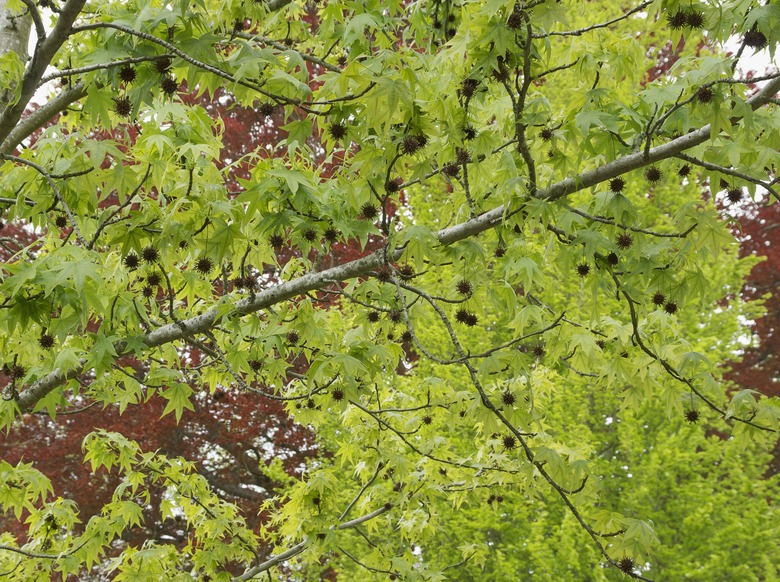
Large palmate sweetgum leaves, which are 4" to 8" inches in diameter, have five to seven distinctly separated lobes. When bruised or crushed, the dark green leaves are fragrant.
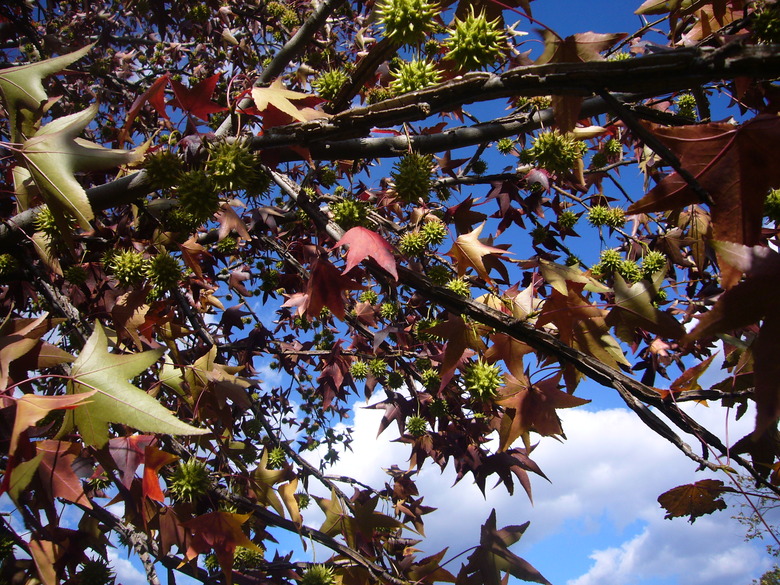
Gumball trees are deciduous trees, losing their leaves in autumn after a brilliant fall color display that may include shades of yellow, orange, purple or red.
Flowers
As a monoecious tree, sweetgum has male and female reproductive structures on each tree. Flowers appear in April to May, and fertilized female flowers begin to enlarge and harden as they form the recognizable fruits called gumballs.
The greenish-yellow flowers are insignificant and tend to form on upper branches, so you'll probably never even notice them.
 Jebulon
Fruit
Fruits initially are green but mature to brown, and many may persist on the tree during winter—although they'll start dropping as early as December and will continue to fall through April. Each round, spiny gumball fruit is 1 to 3 inches in diameter and is comprised of 40 to 60 capsules, each of which contains one or two sweetgum seeds.
An exception to the fruit-bearing species is fruitless sweetgum (Liquidambar styraciflua 'Rotundiloba,' zones 6 to 9). It produces virtually no messy gumball fruits.
Roots
Most of sweetgum's root system is shallow if trees are sited on moist soil, although there may also be some deep taproots if the soil is drier. The shallow roots are strong and aggressive, which is why trees should be sited away from sidewalks and driveways where the root system may buckle or lift these hardscapes.
On the positive side, sweetgum's roots fix nitrogen, which promotes healthy soil for nearby plants.
Wildlife Value
Sweetgum is a host plant for certain caterpillars, including the imperial moth (Eacles imperialis) larvae and hickory horndevil moth (Citheronia regalis) larvae.
Gumball seeds provide a winter food source for many birds, including the American goldfinch (Carduelis tristis) and purple finch (Carpodacus purpureus), as well as other wildlife including squirrels and chipmunks.
References
- Missouri Botanical Garden: Liquidambar Styraciflua
- North Carolina State Extension: Liquidambar Styraciflua 'Gumball'
- North Carolina State Extension: Liquidambar Styraciflua
- North Carolina State Extension: Liquidambar Styraciflua 'Rotundiloba'
- Yale University: American Sweetgum
- Cal Poly UFEI: American Sweetgum
- University of Florida IFAS Extension: Liquidambar Styraciflua – Sweetgum