

What Parts Do Non-Vascular Plants Have?
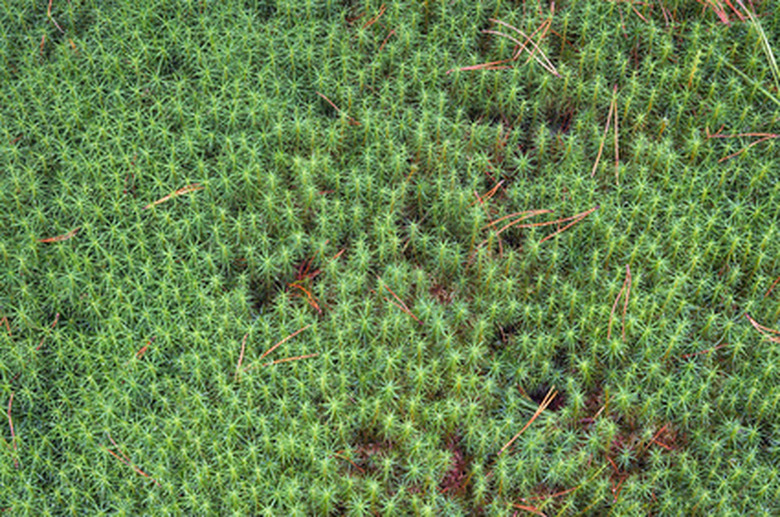
Non-vascular plants include mosses, liverworts and hornworts. This primitive plant group evolved 500 million years ago from green algae and lacks the structure and sophistication of the vascular plants, which have specialized vascular tissues. Non-vascular plants lack xylem and phloem, which provide support and act as conduits for moisture and nutrients in vascular plants. As a result of these deficiencies, non-vascular plants remain relatively small and highly dependent on moist environmental conditions.
Chloroplasts
Chloroplasts contain the green pigment chlorophyll. Chlorophyll converts sunlight, water and carbon dioxide into energy and oxygen through the process of photosynthesis. Non-vascular plants have green, leaf-like parts that contain chlorophyll and supply energy through photosynthesis.
- Non-vascular plants include mosses, liverworts and hornworts.
- Non-vascular plants lack xylem and phloem, which provide support and act as conduits for moisture and nutrients in vascular plants.
Mitochondria
The mitochondria, within each plant cell, break down the sugars and carbohydrates produced through photosynthesis into useful packets of energy that sustain plant life at the cellular level. Non-vascular and vascular plants both have mitochondria.
Nucleus
The nucleus serves as the information processing and management center of the cell. The plant's hereditary information is contained within the nucleus in the form of DNA. All plant and animal cells contain a nucleus.
Rhizoids
Non-vascular plants lack the root systems found in vascular plants and instead have root-like structures called rhizoids. Rhizoids are made of filamentous material and effectively attach the plant to the substrate and provide water absorption.
- The mitochondria, within each plant cell, break down the sugars and carbohydrates produced through photosynthesis into useful packets of energy that sustain plant life at the cellular level.
- Rhizoids are made of filamentous material and effectively attach the plant to the substrate and provide water absorption.
Spores
Non-vascular plants, like some vascular plants including ferns, do not reproduce through seeds and instead reproduce through spores. Spores have a hard outer layer that contains and protects reproductive haploid cells. Haploid cells are essentially copies of parental DNA and can individually mature when environmental conditions permit.