

How To Identify A Peach Fruit Tree By Leaves
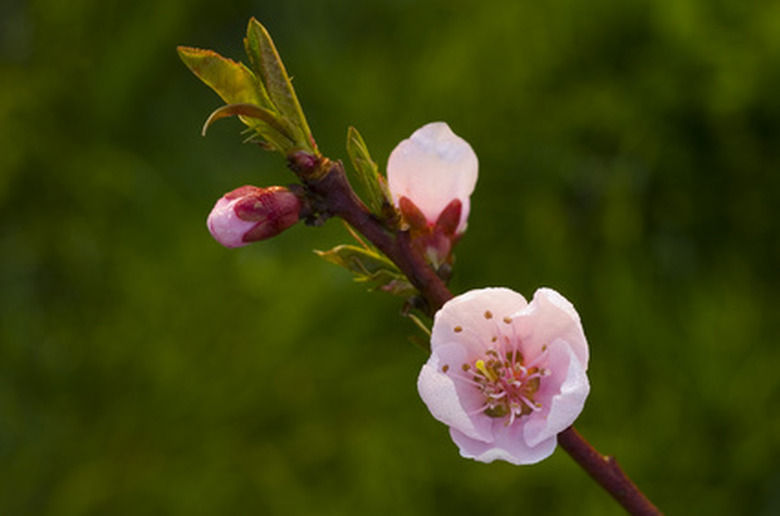
If you can identify a wild peach tree by its leaves, you stand a good chance of harvesting wild peaches for use in jams, pies and eating fresh. With a little practice and some botanical resource images, you can identify peach leaves with confidence. Of course, the best sign you've found a peach tree is the fuzzy green baby peaches that develop in late spring. Begin looking for peach trees in the spring when frost danger passes and local trees begin to flower and leaf out.
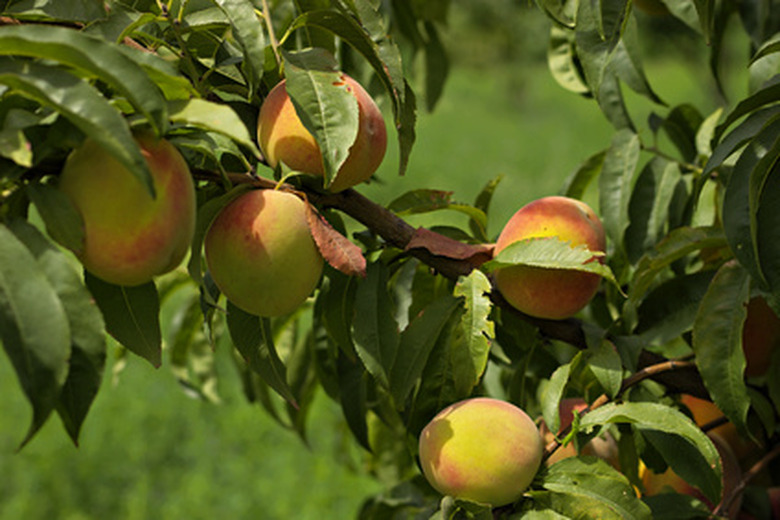
Step 1
Look at the leaf's shape. Peach leaves are cat's-eye shaped and have finely serrated edges. Any leaf that has sharper teeth, smooth edges or bears a different shape is not from a peach tree.
- If you can identify a wild peach tree by its leaves, you stand a good chance of harvesting wild peaches for use in jams, pies and eating fresh.
Step 2
Examine the leaf's color. Peach trees have glossy, deep green leaves. Trees with purple leaves or pale green leaves cannot be peach trees.
Step 3
Check the leaf size. Peach leaves range from 3 to 5 inches long and are 1/3 as wide. Rounder, fatter leaves mean you haven't found a peach tree.
Step 4
Crush the leaf in your hand, then smell it. Peach leaves have an astringent, grassy smell and bitter taste. If the tree's leaves match peach leaves in size, shape and color and also have a grassy smell, you can be confident that you've found a peach tree.
- Peach trees have glossy, deep green leaves.
- If the tree's leaves match peach leaves in size, shape and color and also have a grassy smell, you can be confident that you've found a peach tree.
Peach Tree
If you want peaches to eat out-of-hand, varieties with white flesh are your best bet. Most peaches with white flesh are clingstones. If you want peaches to make into pies or cobblers or to can, a freestone peach is likely best for you. and the pit sometimes falls off by itself. Freestone peaches, almost all yellow, ripen from late July until mid-August, depending on the cultivar. Peach trees grow buds in the summer that are dormant in the winter. This is called their chill requirement. If you live in USDA zones 9 or 10, you should plant a low-chill peach variety, The California Rare Fruit Growers Association has a recommended list of low-chill peaches. August Pride," "Bonanza," "Chelena," "Desert Gold," "Early Gold," "Earligrande" and "Santa Barbara" require from 150 to 250 chilling hours. " Scarlet Robe" needs 350 to 400 hours. "
- If you want peaches to eat out-of-hand, varieties with white flesh are your best bet.