

Uses Of A Cotton Plant
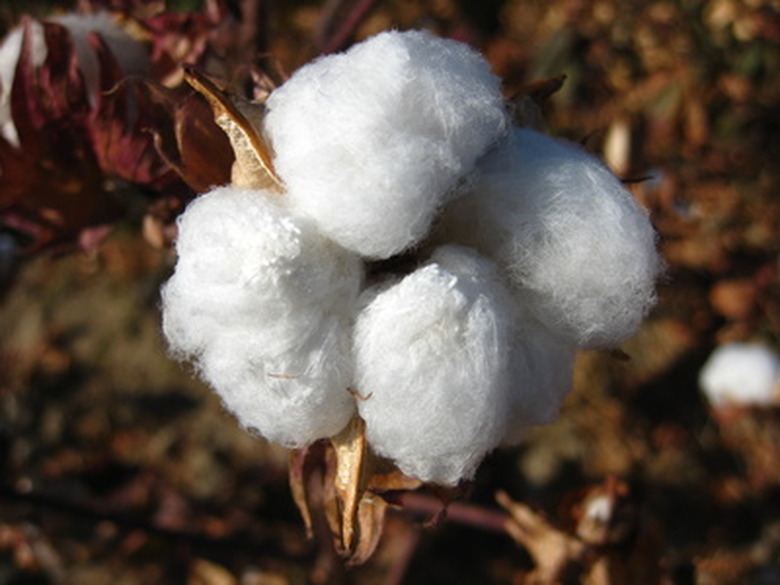
The cotton plant is best known for producing soft, washable fiber, which outsells all others–including man-made fibers–in the United States. But other parts of the plant are also used for various purposes. According to CottonInc.com, cotton has been cultivated for about 7,000 years, and evidence suggests it existed in Egypt as far back as 12,000 B.C. In the United States, the cotton belt spans 17 southern states from Virginia to California, where farmers glean as much use out of plants as they can.
Fiber
Cotton fiber, considered the fruit, grows as small tufts, or bolls, on the ends of stems. It is usually mechanically harvested and used to make a wide variety of products, such as clothing, blankets, hats, furniture covering, sheets, shoe strings, feminine products, money, wallpaper, sails, fire hoses, window shades and books. Its durability and relatively cheap growth helps keep it popular, although product costs vary according to brand name and styling.
- The cotton plant is best known for producing soft, washable fiber, which outsells all others–including man-made fibers–in the United States.
- According to CottonInc.com, cotton has been cultivated for about 7,000 years, and evidence suggests it existed in Egypt as far back as 12,000 B.C.
- In the United States, the cotton belt spans 17 southern states from Virginia to California, where farmers glean as much use out of plants as they can.
Linters
Linters, the short, silky fuzz that cling to each seed after ginning, provides cellulose for making plastics, explosives and other products such as high-quality paper and paperboard and insulation; and batting for mattress padding, furniture and automobile cushions. Cellulose is also used to make cellophane and rayon. Until the 1930s, it was used to make photographs and movie films. Converting cellulose into a biofuel is being explored. Linters have also been refined for use in medical and cosmetic products.
Seeds
According to the National Cotton Council of America, seeds comprise about 2/3 of the harvested crop. The sticky seeds, contained within the white fiber, are extracted and crushed to separate them into oil, meal and hulls. Cottonseed oil is used in snack foods such as cookies and chips. The oil is also used in shortening, cooking oil and salad dressing, and is being incorporated more frequently as companies move away from products containing trans fats. The meal and hulls are used as fertilizer; and as a high-protein supplement in livestock, poultry and fish feed.
- Linters, the short, silky fuzz that cling to each seed after ginning, provides cellulose for making plastics, explosives and other products such as high-quality paper and paperboard and insulation; and batting for mattress padding, furniture and automobile cushions.
- The oil is also used in shortening, cooking oil and salad dressing, and is being incorporated more frequently as companies move away from products containing trans fats.
Stalks and Leaves
After the cotton is picked, the stalks and leaves of cotton plants are plowed under to enrich the soil. Cotton plants are notorious for depleting the soil of nutrients, which is why some farmers till plants back into the land.