

Herbicides
Step 1
Banvel herbicide is a product of the BASF Corporation. Banvel herbicide is used to control many types of broad-leaf weeds in crops. Its main active ingredient is Dicamba, and it can be tanked mixed with a 2,4-D herbicide. It is important that you use Banvel herbicide as directed to effectively kill the weeds. A solution that is too weak won't work, and one that is too strong could harm your crops.
Step 1
Wait for a day with little to no wind, and temperatures between 50 and 77 degrees F to apply the Banvel herbicide.
Step 2
Fill your water tank with 30 to 50 gallons of water.
- Banvel herbicide is a product of the BASF Corporation.
- Its main active ingredient is Dicamba, and it can be tanked mixed with a 2,4-D herbicide.
Step 3
Add 7 to 10 oz. of Banvel herbicide for every acre you need to cover.
Step 4
Turn the tanks agitator on. The herbicide must be mixed continually, and not allowed to sit for any length of time.
Step 5
Set the tank to disperse the mixture as a coarse spray. If your tank has numbers, set it to release at a pressure of 29 psi.
Step 6
Spray during the seedling stage, or when the crops are actively growing.
- of Banvel herbicide for every acre you need to cover.
- Set the tank to disperse the mixture as a coarse spray.
Tip
Keep cattle from grazing on any areas where you used Banvel herbicide for at least one week after the application was made.
Warning
If you have an emergency while using Banvel, call 1-800-454-2673.
Step 1
Prepare for working with your Weedmaster herbicide by putting on a mask to protect your lungs and a pair of goggles to protect your eyes. You will also want to protect your skin by donning a pair of gloves, long-sleeved shirt, long pants and a pair of boots.
Step 2
Pour 5 gallons of water into your garden sprayer.
Step 3
Add 5 fluid oz. Weedmaster herbicide to the water in the sprayer. Mix the two together, and place the lid back on the garden sprayer.
Step 4
Spray liberally across the area of your lawn where you want to control the weeds.
- Prepare for working with your Weedmaster herbicide by putting on a mask to protect your lungs and a pair of goggles to protect your eyes.
- Weedmaster herbicide to the water in the sprayer.
Tip
If an emergency occurs while you are using your Weedmaster herbicide, call a local poison control center or 800-832-HELP (4357).
Warning
Only apply the Weedmaster herbicide on a day when there is no wind. The wind can carry the herbicide elsewhere. Make sure rain is not predicted within 4 hours of applying the herbicide, or you will have to do it again.

According to the Trimec label, the herbicide should be applied in spring or early fall when weeds are actively growing and temperatures are below 85 degrees Fahrenheit and rain is not expected for 24 hours after application. Trimec is a post-emergent herbicide that controls broadleaf weeds.
Triclopyr amine
Triclopyr amine herbicides are used as brush killers and are especially potent against large shrubs such as citrus trees. According to the University of Florida Extension, "brush killers are more dilute than Garlon 3A, are packaged in small quantities (quart containers), and can be purchased at retail garden supplies. They are readily available and convenient for the small property owner to use." Typical brands that contain this potent herbicide include Garlon 3A, Renovate, Brush-B-Gone and Brush Killer.
Glyphosate
Glyphosate herbicides are used by commercial and professional land managers. The brands that contain this herbicide include Roundup and Grass Killer Super Concentrate. This herbicide is available at all local garden centers.
- According to the Trimec label, the herbicide should be applied in spring or early fall when weeds are actively growing and temperatures are below 85 degrees Fahrenheit and rain is not expected for 24 hours after application.
- Typical brands that contain this potent herbicide include Garlon 3A, Renovate, Brush-B-Gone and Brush Killer.
Imazapyr
Imazapyr is used for aquatic sites. This is by far the most potent herbicide available and is not recommended for home use. Imzapyr is taken up into the tree's roots and will cause severe injury or mortality. Arsenal and Habitat are the two brands that contain Imzapyr.
Function

Step 1
Arsenal herbicide provides effective, long-term control for a multitude of annual and perennial grasses, weeds and trees.
Uses
Step 1
Arsenal herbicide can be used to clear unwanted vegetation from areas such as train tracks, roadside sites, parking lots and fire walls.
Features
Step 1
The herbicide is applied as a spray solution and is absorbed by the treated plant's leaves, stem and roots.
Step 2
- Imazapyr is used for aquatic sites.
- Imzapyr is taken up into the tree's roots and will cause severe injury or mortality.
Considerations
Step 1
Arsenal herbicide is non-selective, meaning it indiscriminately affects both desirable and undesirable vegetation.
Effects
Step 1
The ingredient imazapyr has been classified as practically non-toxic to mammals. It is not believed to cause cancer or birth defects in humans.
Warning
Step 1
When handling the herbicide, avoid contact with clothing, skin and eyes. If contact occurs, call a doctor or poison control center.
Step 1
Hand-pull small amounts of spurge in lawns. Wear latex or rubber gloves as the plant leaks a milky sap that may cause skin irritation.
Step 2
- Arsenal herbicide is non-selective, meaning it indiscriminately affects both desirable and undesirable vegetation.
- When handling the herbicide, avoid contact with clothing, skin and eyes.
Step 3
Apply a pre-emergent herbicide containing pendimethalin, isoxaben or dithiopyr. Check the soil temperature 1 inch deep in the spring and apply the herbicide when the soil reaches 55 degrees Fahrenheit.
Step 4
Withhold water for 24 hours after the herbicide application unless the product's label suggests otherwise.
Step 5
Spray any remaining spurge in the summer with a spot spray labeled for use on broadleaf weeds.
Step 1
Buy Milestone from licensed agrochemical dealers and retailers throughout the country. As of spring 2010, Dow lists 21 distributors across the United States and provide their online and telephone contact information (see link in the Resources section).
Step 2
Purchase Milestone products directly from the Dow AgroSciences sales representative assigned to your region of the country. You can get in contact with that person directly by accessing the "Find Your Sales Representative" interactive tool on the Milestone product Web page. (The Web link is in the Resources section).
- Apply a pre-emergent herbicide containing pendimethalin, isoxaben or dithiopyr.
- Purchase Milestone products directly from the Dow AgroSciences sales representative assigned to your region of the country.
Step 3
Be prepared to pay the going retail rate of Milestone herbicide, which as of January 2010, is about $332 per gallon. This makes Milestone more expensive than many herbicides on the market by volume, but not the most costly and does not take into account effectiveness or require rate of use.
Warning
According to Dow AgroSciences, the sale of Milestone is not a federally restricted and in most states you will not need a license to either buy or apply it, but in some states you may. This requirement can be determined by contacting your state department of agriculture or a local university cooperative extension service.
Step 1
Fill a spray bottle with the herbicide, diluted as recommended on package instructions. Add enough food coloring to thoroughly dye the solution so that you will be able to see where you are spraying it. This should be done in early spring when rain is not expected for at least one hour.
Step 2
Cut the knotweed back to within 2 to 3 inches of the soil using the lopping shears. Make the cuts as smooth as possible to ensure that the herbicide is easily absorbed by the stems.
- Be prepared to pay the going retail rate of Milestone herbicide, which as of January 2010, is about $332 per gallon.
- This makes Milestone more expensive than many herbicides on the market by volume, but not the most costly and does not take into account effectiveness or require rate of use.
Step 3
Spray well around the top of the stem with the herbicide. It is important that you spray the stems immediately after cutting because the plant quickly begins to develop a protective seal after being wounded.
Step 4
Wait at least seven days before you attempt to mow over the remaining stems. This will give the herbicide a chance to penetrate to the roots.
Step 5
Re-treat in the same manner in early fall.
Tip
Mix a 2 percent solution of glyphosate concentrate to spray on the leaves of the plant, but avoid saturating it so heavily that it drips onto surrounding plant life. You can dig knotweed up if you live in an area where chemical use is prohibited or if the weed has invaded a space close to your garden or flowers.
Warning
Wear latex gloves at all times when using the herbicide solution. Do not spill the herbicide on your lawn or next to plants because it will cause extensive damage.
Step 1
Step 1
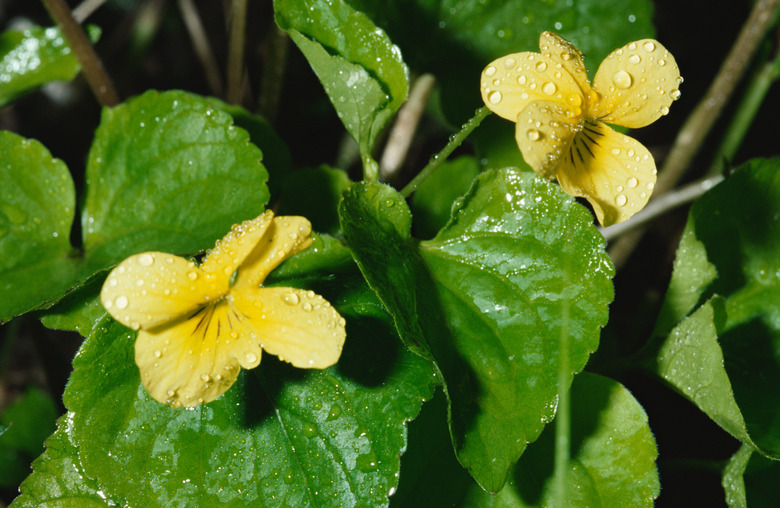
Apply herbicide to common violet weeds in the fall. Although the wild violets can detract from your lawn's appearance, herbicide is more effective in autumn when the plants are preparing for winter by transporting food down to their root systems.
Step 2
- Spray well around the top of the stem with the herbicide.
- Although the wild violets can detract from your lawn's appearance, herbicide is more effective in autumn when the plants are preparing for winter by transporting food down to their root systems.
Step 3
Apply the dicamba selective herbicide on a calm, sunny day with temperatures between 60 and 80 degrees. Spray the area around the violets thoroughly with the herbicide and saturate the entire plant above the soil level.
Step 4
Wait two to three weeks for the violet plants to wither and die back. Reapply the herbicide if any plants remain after this period.
Step 1
Transfer liquid herbicide with glyphosate into a garden sprayer and pump the sprayer to prepare it for use.
Step 2
Protect your eyes with a pair of goggles and be sure to wear closed-toe shoes and long work pants to prevent contact with the skin.
Step 3
Cover nearby plants and vegetation with drop cloths as the herbicide can harm both plants and grass.
- Apply the dicamba selective herbicide on a calm, sunny day with temperatures between 60 and 80 degrees.
- Transfer liquid herbicide with glyphosate into a garden sprayer and pump the sprayer to prepare it for use.
Step 4
Press the lever on the wand of the garden sprayer and aim the herbicide directly onto the blades of unwanted grass. Soak the grass entirely with the herbicide.
Step 5
Monitor the bad grass over the course of a week. Reapply the herbicide if necessary.
Developed in 1945, 2,4-D ( 2,4-dichlorophenoxyacetic acid) is widely used across the world as an effective, selective herbicide. Primarily used for broadleaf control, it is not designed to be effective against crabgrass.
Step 1
Put on rubber gloves and a dust mask to protect your skin and lungs from any harmful effects that may arise from the herbicide.
- Press the lever on the wand of the garden sprayer and aim the herbicide directly onto the blades of unwanted grass.
- Soak the grass entirely with the herbicide.
Step 2
Dilute a selective herbicide with water in a bucket. Follow the directions on your particular herbicide as the recommended ratio may differ from product to product.
Step 3
Fill the tank of a lawn sprayer with the herbicide. Do not exceed the fill line on the tank.
Step 4
Spray the herbicide directly on the stinkweed until it is completely coated in liquid. Continue this until all of the stinkweed in the yard is sprayed.
Tip
Read the manual for the lawn sprayer before you attempt to use it to ensure the best possible results. Apply the herbicide on a dry day. Apply the herbicide before the ground begins to frost over in fall.
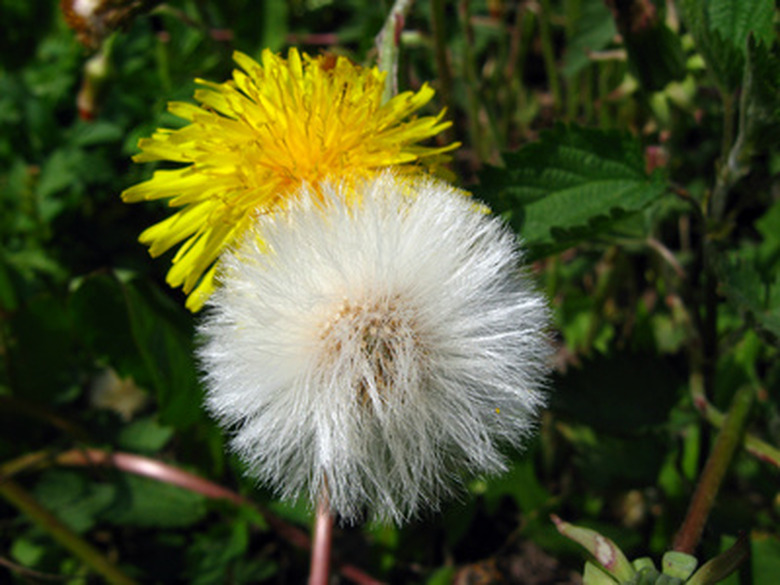
Dandelions and other weeds are best controlled with an herbicide that contains 2,4-D, according to the University of Minnesota Extension. This ingredient is found in broad-leaf herbicides such as Barrage, Plantgard and Weedtrine-II.
- Dilute a selective herbicide with water in a bucket.
- Spray the herbicide directly on the stinkweed until it is completely coated in liquid.
Sempra is a selective herbicide designed to kill nutgrass or nutsedge weeds. It is commonly used on corn and sugarcane crops. Also Sempra can be used to control nutgrass in cotton crops.