

How To Plant Allium Bulbs
Things Needed
- Allium bulbs
- Spade or garden fork
- Leaf mold, aged manure, peat moss or ground bark.
- Fertilizer
- Bone meal
- Trowel
- Planting stakes
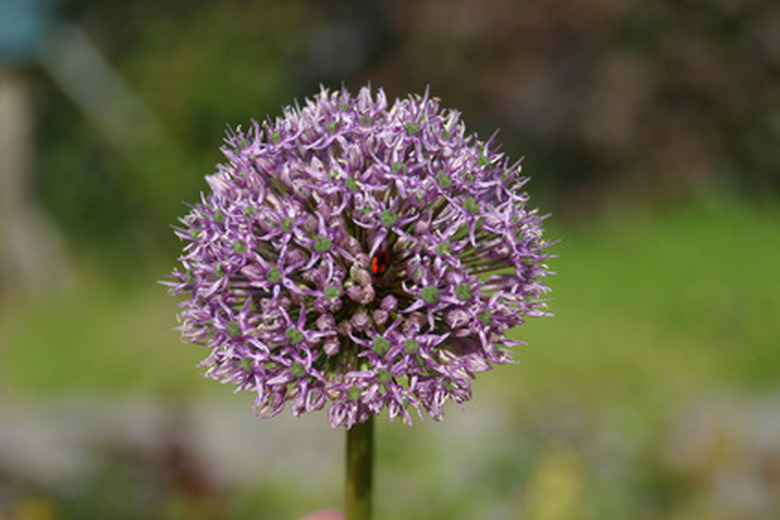
Alliums are a group of flowering plants related to the edible onion. They can grow to between 4 inches and 4 feet tall, depending on the variety. Several varieties of allium are known for their fragrant flowers, which come in violet, red, pink, white, yellow and various shades of rose and blue. Plant allium bulbs in full sun and provide them soil that is rich in organic matter.
Step 1
Choose a planting location for the allium bulbs that will provide as much sunlight as possible. Loosen and turn over the soil in the planting location to a depth of 12 to 14 inches with a garden fork or spade.
Step 2
Spread a 2- to 3-inch layer of organic matter such as leaf mold, aged manure, peat moss or ground bark over the planting area. Mix the organic matter into the soil using a garden fork or a shovel.
- Alliums are a group of flowering plants related to the edible onion.
- Mix the organic matter into the soil using a garden fork or a shovel.
Step 3
Apply a bulb-type fertilizer, such as 4-10-6 or 5-10-20, to the planting area. Use 5 tbsp. for every 10 square feet of planting area. To ensure strong roots, broadcast 2 cups of bone-meal for every 10 square feet of planting area, as suggested by the University of Illinois. Mix the fertilizer and bone meal into the soil thoroughly.
Step 4
Dig planting holes 6 inches deep, for smaller varieties of allium bulbs. Space each planting hole 4 to 6 inches apart. For larger or giant varieties, dig planting holes approximately 8 inches deep and space each hole approximately 8 to 12 inches apart.
- Apply a bulb-type fertilizer, such as 4-10-6 or 5-10-20, to the planting area.
- To ensure strong roots, broadcast 2 cups of bone-meal for every 10 square feet of planting area, as suggested by the University of Illinois.
Step 5
Plant one allium bulb in each planting hole. Plant the bulbs with the pointed end of each bulb facing upward.
Step 6
Cover the allium bulbs with 6 inches of soil and organic matter mixture, if you are planting smaller allium varieties. For larger allium varieties, cover up each bulb with approximately 8 inches of soil.
Step 7
Push in 12- to 14-inch-tall planting stakes around the perimeter of the planting area. This marks the location so you will avoid stepping on the area as well as indicates where you need to water.
Step 8
Water the planting area thoroughly. Let the water run slowly so it has time to reach down to the planting depth of the allium bulbs.
- Plant one allium bulb in each planting hole.
- Cover the allium bulbs with 6 inches of soil and organic matter mixture, if you are planting smaller allium varieties.
Tip
Plant allium bulbs in early spring (late February through mid-March) or fall (late September through mid-November). Fertilize allium bulbs once a month as soon as shoots emerge. Use a 10-10-10 or similar bulb-type fertilizer. Use 7 tbsp. of fertilizer to every 10 square feet of planted area. Water the allium bulbs when the soil feels dry to the touch down to a depth of 2 inches. Over-watering allium bulbs will cause the bulbs to rot.