

Burdock
Step 1
Fresh burdock root, unlike the carrots to which its shape is similar, is not tasty when raw. However, cooking it brings out some of its natural sweet, earthy flavors. It is a staple of Japanese cuisine, and is full of vitamins, minerals and fiber. It is also reputed to be a natural digestive aid. Fresh burdock root is quick and easy to prepare.
Step 1
Peel the burdock roots. Like parsnips and carrots, you should peel these in long strips.
- Fresh burdock root, unlike the carrots to which its shape is similar, is not tasty when raw.
- Fresh burdock root is quick and easy to prepare.
Step 2
Cut burdock roots in half and lay the flat sides down. Slice them lengthwise, thinly, into 1/4-inch thick segments. If the roots are long, cut them in half. If they are very long, cut into thirds. Continue turning and cutting the roots until the pieces look about the size of french fries.
Step 3
Heat your pan over high heat. Add 1 tsp. sesame oil and swirl to coat the bottom of the pan.
- Cut burdock roots in half and lay the flat sides down.
Step 4
Mix burdock root pieces with the soy sauce, mirin and sugar in the bowl until all the pieces get coated.
Step 5
Add the seasoned burdock root pieces to the hot pan. Stir often to cook on all sides and do not burn. They will cook quickly, and will absorb the sauce as they cook. They will start to turn a lovely soy-glazed brown color.
Step 6
Add sesame seeds and chili flakes at the end, if you like. Stir the burdock roots and these last two seasonings all together. Serve at any temperature you like. They can be reheated, but do not require it to taste good.
- Mix burdock root pieces with the soy sauce, mirin and sugar in the bowl until all the pieces get coated.
Tip
In Japanese, this is a classic dish called "kinpira gobo." "Gobo" means 'burdock root" in Japanese, and "kinpira" refers to the cooking method, which is a combination of sauteing and simmering. Kinpira-style cooking works well with most root vegetables. Try to make the pieces of the burdock as similar in size as you can to ensure even cooking. Also, do not leave the pieces too large, or they will take too long to cook and will start to burn.
Things Needed
- 2 to 3 burdock roots
- 2 tsp. soy sauce
- 2 tsp. mirin (Japanese sweet cooking wine)
- 1 tsp. sugar
- 1 tsp. sesame oil
- 1 tbsp. sesame seeds (optional)
- 1 tsp. crushed red chili pepper flakes (optional)
- Sharp chef's knife
- Large skillet or saute pan
- Long-handled spoon or chopsticks
- Large bowl
- Vegetable peeler
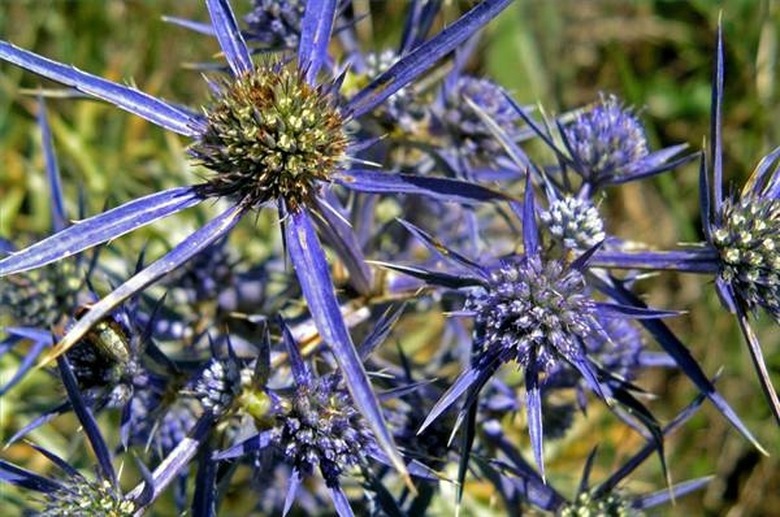
Identification

Step 1
The burdock plant is a member of the thistle family. The leaves of the plant are heart shaped, wavy and dull green. The roots are brown-green or black. The spiny and prickly tops of the plants break off and stick to hair and clothing as burrs. There are many varieties of burdock and the flowers vary in color.
History
Step 1
Burdock originated in Asia and Europe and has been used as a medicinal plant for hundreds of years. The roots have also been used in food dishes and drinks. There has been little to no scientific research done on the medicinal properties of burdock although traditional Chinese medicine has used the roots and leaves to great effect.
Step 2
- The burdock plant is a member of the thistle family.
- There are many varieties of burdock and the flowers vary in color.
Geography
Step 1
Burdock plants spread from Asia and Europe to most of the world. It now grows wild throughout most areas. In Europe and America it is produced and harvested as an herbal treatment and supplement.
Function
Step 1
The root of the burdock plant has been used as a blood purifier and a diuretic. It is also used as a digestive aid. Chinese herbal remedies use burdock to treat colds, sore throats and other illnesses. Topical uses include treatment of skin ailments such as acne and eczema as well as dandruff and hair loss.
Step 2
- Burdock plants spread from Asia and Europe to most of the world.
- The root of the burdock plant has been used as a blood purifier and a diuretic.
Warning
Step 1
There has been proof that burdock can interfere with the function of some medications used for diabetes. Diabetics should only use herbal remedies containing burdock under the supervision of a physician.
Fun Fact
Step 1
Swiss inventor George de Mestral examined the burrs of a burdock plant in the 1940s. His examination resulted in the invention of velcro.
Identifying Burdock
Young burdock is nothing to marvel at: it is a cluster of veiny green leaves growing close to the ground. The leaves of young burdock are shaped like shovels. The leaves can grow to be large: 2 feet long and 1 foot wide. As the plant matures into its second year, you will notice a central flower stalk. The stalks grow between 2 and 9 feet tall.
- There has been proof that burdock can interfere with the function of some medications used for diabetes.
The plant will also sprout flowers. The flowers of a burdock plant are like spiky orbs with purple bristles popping out of the top. After the plant flowers, fruits form. The fruits of this plant, however, are not your conventional apple or orange.
Burdock fruits are brown burrs. These burrs tend to stick to everything, such as pant legs and coat sleeves. Each fruit contains burdock seeds. These look like small, moon-shaped chips of wood. The plant is native to Europe and Asia.
- The plant will also sprout flowers.
- The flowers of a burdock plant are like spiky orbs with purple bristles popping out of the top.
Step 1
Gather your seeds from burdock plants by removing the burrs in the fall. If the burrs come off easily, the seeds are ready. Buy your seeds if you don't have access to wild plants.
Step 2
Pick a spot of your yard that has deep, rich and sandy garden soil. Loose soil will make it easier for you to harvest the roots later. Make sure the area you are going to grow your burdock in is either a sunny location or gets partial shade.
Step 3
Sow your burdock seeds directly into the soil in early spring or summer. Press each seed 1/4 inch into the ground and cover with soil.
- Gather your seeds from burdock plants by removing the burrs in the fall.
Step 4
Water your burdock daily to keep the soil damp, but not soggy.
Step 5
Thin your burdock plants once they begin growing so that they are 4 inches apart. Typically, burdock begins growing after 2 weeks.
Step 6
Weed your burdock regularly, especially while the plants are still young.
Step 1
Scrub the fresh burdock root vigorously under cold running water to remove any dirt. Do not peel. If you are using dried burdock root, you may skip this step.
- Water your burdock daily to keep the soil damp, but not soggy.
- Thin your burdock plants once they begin growing so that they are 4 inches apart.
Step 2
Cut the fresh burdock root on the bias into slices. If you are using dried burdock root, it may already be in pieces. Make sure pieces are no larger than 1 inch in length.
Step 3
Submerge the burdock root pieces (either the entire single fresh burdock root or 1/4 cup dried) in two to three cups of water in your saucepan.
Step 4
Boil burdock root in water on the stove. When the water has come to a rolling boil, set timer for 30 minutes, and put the lid on the saucepan. Reduce heat slightly, so that it does not boil over.
- Cut the fresh burdock root on the bias into slices.
- Boil burdock root in water on the stove.
Step 5
Pour the tea into your mug and enjoy, being careful to avoid the root pieces. Adjust the sweetness to your liking with honey or sugar.
Tip
Burdock root has been used to treat diabetes and as an aid to cancer patients. According to the National Institute of Health (NIH), however, such claims require further research. As of January 2010, enough evidence exists that the NIH has not declared these claims false. You will have enough tea from this recipe for a few servings. If you like it, you can continue to drink it throughout the day, but don't drink too much. This tea, like many other teas, can have undesirable diuretic effects, if too much is consumed. You can re-infuse the burdock pieces you use for this tea once after the original process, but realize the flavor will not be quite as strong. It's not advisable to re-infuse the root more than once.
Things Needed
- 1 burdock root (fresh) or packet of dried burdock roots
- Sharp chef's knife (optional)
- Vegetable scrub brush (optional)
- Cutting board (optional)
- Mug
- Medium saucepan with lid
- Water
- Timer
- Honey or sugar (optional)