

How To Care For Old Grapevines
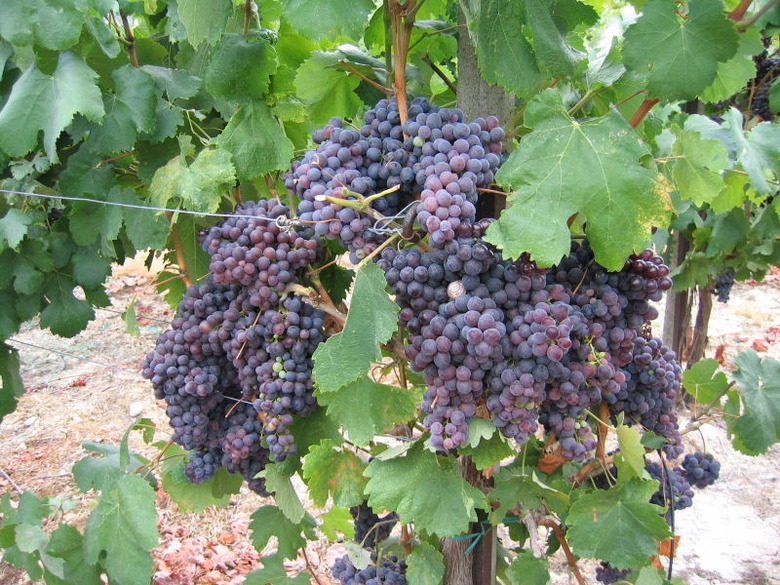
Things Needed
- Pruning clippers
- Pruning loppers
- Compost or humus
- T-shaped trellis
- Mulch
- Water
Tip
Grapevines need pruning on a yearly basis, preferably in the winter. To keep the plant from falling into neglect again and possibly dying, prune the plant every year. Prune back old wood since fruit will appear only on new wood. If you choose to perform a radical rejuvenation pruning to the plant, be patient for a few years. The plant will bounce back with proper watering and attention. Make sure to train new vines onto the trellis as needed.
Buried along the fence line lies a tangle of old grapevines. Year after year, you promise to straighten this garden nightmare, clip back the vines and provide a new support system. Every year, the vines get ignored. Despite this neglect, leaves form and sometimes even fruit. Caring for old grapevines simply require a little attention to rejuvenate these older plants. While some plants may be past the fruit-producing stage, grapevines and leaves create a beautiful canopy on an arbor.
Step 1
Begin your rejuvenation by assuming the soil has been as neglected as the grapevine. Dump a good layer of compost or humus into the soil around your vines. Add a 4-inch layer of mulch to the top to increase the organic components in the soil.
- Buried along the fence line lies a tangle of old grapevines.
- While some plants may be past the fruit-producing stage, grapevines and leaves create a beautiful canopy on an arbor.
Step 2
Examine the plant to evaluate how much pruning the plant requires. The healthiest vines have a central trunk and two cordons (horizontal vines) extending off the top of the plant to form a T-shape. Look for areas of wood far away from the main trunk. This wood used to be year-old "fruiting" wood that provided nutrients for the forming grapes.
Step 3
Prune any dead or diseased vines off the plant, including the cordon and trunk branches. If a trunk appears to be dead, clip it down to the ground. This encourages new growth as well as the entirely new creation of a sucker, a new trunk. Any clipped vines should be completely removed from the trellis and discarded.
- Examine the plant to evaluate how much pruning the plant requires.
- The healthiest vines have a central trunk and two cordons (horizontal vines) extending off the top of the plant to form a T-shape.
Step 4
Choose the healthiest cordon (if there are any) and leave these alone. Look for green vines and leaves even though these may be sparse. Prune back all other cordons to the trunk of the grapevine. If there aren't any healthy cordons, trim back the plant to the trunk. Your aim lies in encouraging fruit wood growth closer to the trunk.
Step 5
Leave the grapevine alone to see what happens with the natural replenishment of the growing process. When new cordons form, remove the older wood to encourage strong new cordon development.
- Choose the healthiest cordon (if there are any) and leave these alone.
- If there aren't any healthy cordons, trim back the plant to the trunk.