

How To Put Lime Pellets Down With Grass Seeds
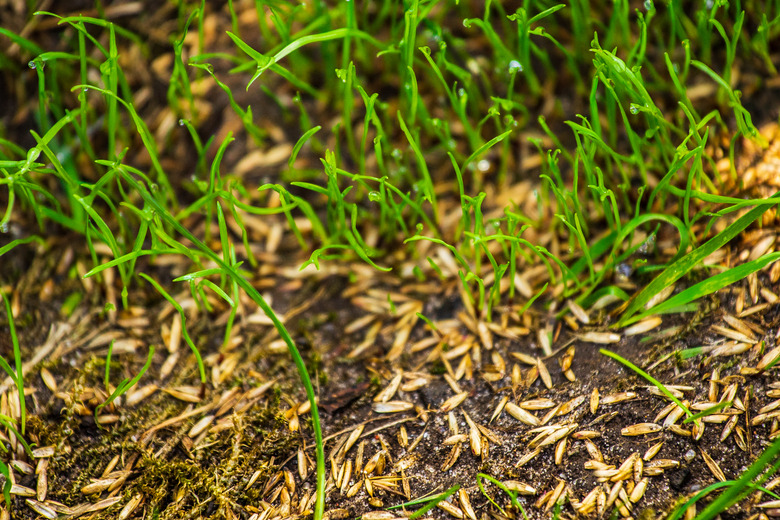
If you're in a hurry to sow a new lawn and you know your lawn needs lime to raise the soil pH, can you apply lime and grass seed at the same time?
You can, and the lime won't harm the grass seed. But lime doesn't change the pH instantly, so you will be sowing your grass seed in a less-than-ideal environment. **The best practice is to add lime before sowing seed or laying sod.**
Why Add Lime to Your Lawn?
Many soils have a low pH, which is defined as anything below 6.5. Some plants do best in a somewhat acidic environment, between 5.5 and 6.5 pH, but a pH lower than 5.5 is an inhospitable environment for almost all plants. That's because a too-low soil pH makes it impossible for plants to get the nutrients they need from the soil. Further, some elements become too available, such as aluminum, which can burn a plant's roots.
To counteract this, farmers and gardeners add lime to the soil to make the soil more alkaline. The need to add lime is so frequent that the word has even become a verb, as in "When should I lime the soil?" It is also called "sweetening" the soil.
Lime is not always a good thing, though. It raises the soil pH, but if you already have an alkaline soil, lime can harm plants by making the soil too alkaline. In that case, nutrients again become unavailable to plants. Further, acid-loving plants like some ornamentals (think rhododendrons, azaleas, camellias) and fruits (blueberries, cranberries, huckleberries) will suffer in a pH higher than 6.5.
The only way to know whether you should add lime is to take a soil test. You can find a soil test kit at garden centers, but commercially available kits are not always accurate. For accurate results, ask your local university extension office, which can direct you to a local source for testing or even process the tests for you.
Tip
Most grass varieties prefer a pH that is slightly acidic to neutral, or 6.2 to 7.0. Find out the desired pH of the grass seed you are sowing before liming the soil.
How to Add Lime, Ideally
The best way to add lime is to till or dig it into your soil to a depth of about 6 inches. This clearly means that you should, ideally, lime your soil before you sow your grass seed. How long before? That depends on the acidity of your soil. **Very acidic soil is likely to see improvement within just a few weeks, but soils that are just a little acidic may take at least one growing season to improve.**
Choosing the Right Type of Lime: Calcitic vs. Dolomitic
Two types of limes are used in farming and gardening: 1) calcitic lime, which is also called "agricultural lime" and made from pulverized limestone high in calcium carbonate; and 2) dolomitic lime is made from dolomite, which is similar to limestone but also contains magnesium.
Both are equally effective at raising soil pH, but dolomitic lime is likely to be more expensive, so use it only if your soil test reveals a magnesium deficiency. Be aware, however, that adding high levels of calcitic lime can actually induce a magnesium deficiency.
What About Lime Pellets?
Some manufacturers of lime pellets claim that the lime breaks down more quickly in pellet form and can result in a higher pH sooner than when regular, pulverized lime is used. Studies have not corroborated this, and pelletized lime does not raise soil pH any faster, reports the University of Kentucky.
Lime pellets are, however, easier to handle and a lot less messy to apply. Moreover, the dust from straight pulverized limestone can not only blow all over your yard, but also get in your lungs, never a good thing.
Warning
If your soil test reveals a very low pH, postpone sowing grass seed. First lime the soil, wait a full growing season; then plant.
How to Add Lime Pellets While Seeding a Lawn
If your grass seed is in hand, the time of year is right and you have not limed your soil but you really want to get your lawn in—go ahead and start sowing your seed. If your soil is only slightly acidic, the worst that can happen is that your lawn won't green up the way you would like until its second growing season.
The process is easy:
1. Prepare your soil as you normally would before sowing grass seed by tilling it down about 6 inches and smoothing it level. 2. Determine how much pelletized lime you will need, usually about 15 to 30 lbs. per 1,000 square feet. 3. Place the lime pellets in a broadcast spreader, calibrate it for the size of lime pellets and your application rate; then spread the pellets. 4. Place the grass seed in the spreader, calibrate it for your seed and application rate; then spread the seed. 5. Tamp it down and water thoroughly.
Tip
Don't mix the grass seed with the pellets in the broadcast spreader, because they are different sizes and their application rates will differ.
References
- University of Kentucky: Pelletized Lime
- Michigan State University Extension: Should I use Dolomitic or Calcitic Lime?
- NC State Cooperative Extension: Southeastern NC 4-H Youth Development Agriculture & Food Animal Agriculture Aquaculture Commercial Horticulture, Nursery & Turf Farm Health & Safety Field Crops Food Safety & Processing Local Foods Pest Management Specialty Crops Community Forest Resources Health & Nutrition Home & Family Lawn & Garden Extension Master Gardener℠ Volunteers Soil, Water & Air Publications & Factsheets Have a Question Search this website Search Does Your Lawn or Garden Need Lime?
- Jonathan Green Lawn Care: Best pH For Lawn Soil
- Braen Stone: Top 10 Aglime Questions Answered