

Fruit Trees In The Rainforest
Rainforests have tropical climates that receive up to 80 inches of rain per year, which is excellent for the water requirements of fruit trees. The soil quality in rainforests is usually very poor. Fruit trees often provide their own nutrients from rotting fruit that falls from the trees. They also get nutrients from leaves that have fallen and decayed. Most fruit trees are deciduous, which means they lose their leaves once a year.
Mango
The mango tree (Mangifera indica L.) is a deciduous evergreen that can grow up to 100 feet tall and 125 feet in width. The flowers bloom in the spring and are small and white. The fruit takes up to six months to ripen and has a tough, thick skin that is orange to red in color. The flesh of the fruit is pale yellow to orange and resembles that of a peach. The tree prefers well-drained soils and full sun.
- Rainforests have tropical climates that receive up to 80 inches of rain per year, which is excellent for the water requirements of fruit trees.
Banana
The banana tree (Musa sapientum) is an herbaceous evergreen perennial that is native to tropical southeast Asia. The tree must have 10 to 15 months of frost-free weather in order to produce a flower stalk for fruit production. The white flowers are tubular and grow in clusters around the flower stalk. It produces a fleshy fruit that grows up to 12 inches in length. They begin dark green in color and turn yellow or red when fully ripe. The main stem of the banana tree can grow up to 25 feet tall with leaves that grow up to 9 feet long and 2 feet wide. Bananas grow best in full sun and rich, well-drained soils.
- The banana tree (Musa sapientum) is an herbaceous evergreen perennial that is native to tropical southeast Asia.
- They begin dark green in color and turn yellow or red when fully ripe.
Papaya
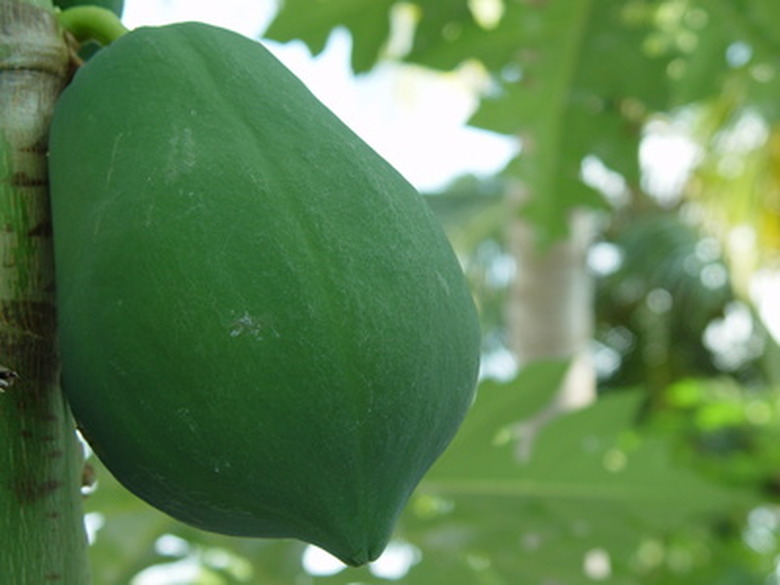
Papaya (Carica papaya) is also referred to as the paw paw fruit. It is a fast growing perennial herb that can grow up to 20 feet in height. Papaya fruit is native to Mexico but grows in tropical or subtropical climates. The fruit is soft and spherical when it is ripe and grows up to 20 inches in diameter. The plants prefer warm temperatures and cannot tolerate temperatures below 32 degrees F. They need full sun, light well-drained soils and plenty of moisture.
Calabash
The calabash tree (Crescentia cujete) is a small evergreen tree that grows up to 30 feet tall. It produces a toxic spherical fruit that grows up to 12 inches in diameter. The fruit is not harmful when eaten in small amounts, but larger amounts can cause skin irritation or an allergic reaction in people. The flowers bloom in the spring and are yellow-green in color with red and purple veins. The leaves are elongated and pinnate and are up to 6 inches long. The tree prefers full sunlight and well-drained clay or loam soils.
- Papaya (Carica papaya) is also referred to as the paw paw fruit.
- The fruit is soft and spherical when it is ripe and grows up to 20 inches in diameter.