

Flowers For The North Side Of A House
On the north side of a house, flowers need to tolerate or thrive in shade, as the sun is unable to shine brightly from the north, creating shaded growing spaces. Choose vivid perennials and annuals for added interest and color to an otherwise low impact area. Remember that though lighting is lower than other areas, plants may still receive some direct sunlight, so choose plants that thrive in both sunny and shady conditions.
Coral Bells
Coral bells (Heuchera sanguinea) are commonly grown perennial plants that display spires of flowers in salmon, white, red and pink hues, with foliage in one of several possible colors, including solid or variegated green, red, purple, yellow, silver or white. Thriving in full sunlight to partial shade, coral bells are appropriate for growth on the north side of a house. Blooming in May to July, coral bells prefer moist, well-drained soil high in organic content. This perennial flower grows to a height of 12 to 18 inches; plant in USDA Hardiness Zones 3 to 8, as directed by the University of Illinois Extension.
- On the north side of a house, flowers need to tolerate or thrive in shade, as the sun is unable to shine brightly from the north, creating shaded growing spaces.
- Thriving in full sunlight to partial shade, coral bells are appropriate for growth on the north side of a house.
Violets
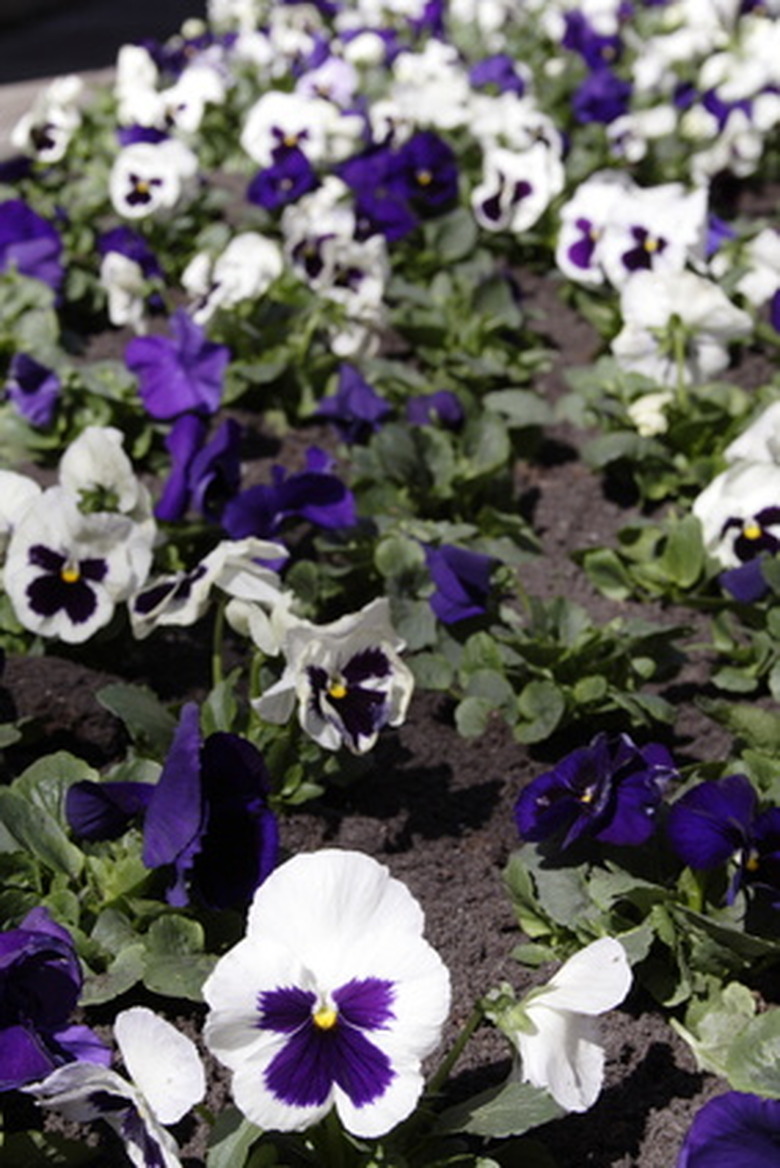
Violets (Viola x writtrockiana), also referred to as pansies, are annual plants that display flowers in solid or bi-color combinations of yellow, white, red, blue and peach, with green foliage. Thriving in partial sun to partial shade, violets are ideal for the north side of a house. Grow violets in rich, moist soil; tolerances include acid soil, loam, clay and sand. Violets reach a height of 6 to 12 inches and are appropriate for planting in any of the USDA Hardiness Zones, according to the University of Florida IFAS Extension.
Impatiens
Impatiens (Impatiens wallerana) are one of few annual plants that thrive in shaded conditions and bear flowers in vibrant colors, making them a suitable addition to the north side of a house. Displaying a vast array of different color options, impatiens are available in white, lavender/blue, violet, orange, red, salmon, rose and pink, with green foliage. Because impatiens thrives in partial to filtered shade, it is important to keep them out of afternoon sun to prevent color-fading of petals. Grow impatiens in moist soil with a layer of mulch. Impatiens grow to a height of 6 to 18 inches with a spread of 10 to 24 inches, according to the Clemson University Extension. You may plant impatiens in any USDA Hardiness Zone, according to the University of Florida IFAS Extension.
- Violets (Viola x writtrockiana), also referred to as pansies, are annual plants that display flowers in solid or bi-color combinations of yellow, white, red, blue and peach, with green foliage.
- Impatiens (Impatiens wallerana) are one of few annual plants that thrive in shaded conditions and bear flowers in vibrant colors, making them a suitable addition to the north side of a house.