

Varieties Of Tall Sedum
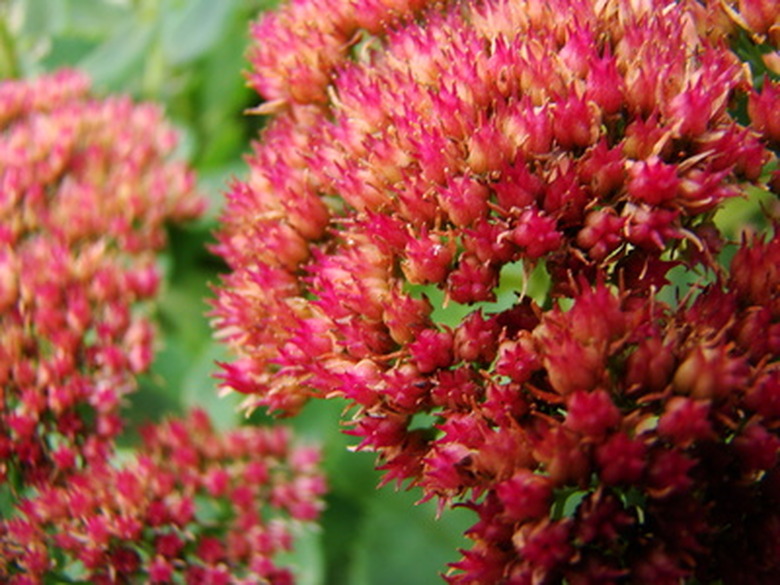
The sedum genus is a large one, including just under 300 species. It is part of the same Crassulaceae family as the familiar jade tree, with similar fleshy leaves. Sometimes also known as "stonecrop", sedums are among the most valuable garden plants. Cultivated varieties are generally drought tolerant and vigorous, with flowers that are attractive to butterflies and pollinating insects. Recently plant taxonomists moved tall (18 inches or more) ornamental sedums, including the popular Sedum spectabile and its hybrids, into the genus Hylotelephium. However, many horticulturalists and merchandisers still refer to these plants as sedums.
Most Popular
The most popular tall sedum on the market is "Autumn Joy", hybrid that resulted from the 1955 crossing of two species, Sedum spectabile and Sedum telephium. It grows to be about 24 inches tall, with large broccoli-like flowerheads that develop during the summer. The star-shaped flowers are pale green at first, then ripen to rosy pink in the early fall. They age to darker red and finally brown. Even the brown flowerheads provide winter interest if left on the plants at the end of the growing season. A related hybrid, "Autumn Fire", has the same form, but richer fall color.
- The sedum genus is a large one, including just under 300 species.
- The most popular tall sedum on the market is "Autumn Joy", hybrid that resulted from the 1955 crossing of two species, Sedum spectabile and Sedum telephium.
Green Foliage
Among the green-leafed, showy sedums are '"Neon", with electric pink flowers and "Stardust", which has very large, white flowers. "Brilliant"; "Carmen"; "Stardust" and "Steven Ward" all have similar form, with flower colors ranging from palest pink ("Stardust") to nearly red ("Carmen").
Dark Stems
"Cloud Walker" has maroon stems and leaf tips, plus large, pink flowers. "Matrona" features dark red stems, gray-green leaves and pale pink flowers
Variegated Leaves
For lovers of variegated leaves, there is "Variegatum", featuring leaves edged in creamy white and pink flowers.
Low Growing Sedum Varieties
Some sedum varieties produce long, trailing stems covered with thick, succulent leaves. These plants are useful for hanging baskets, where their long stems hang below the pot, and as ground covers, where trailing stems cover the ground as the plant spreads. It reaches a height of 6 to 8 inches at maturity and develops yellow flowers in spring. Many sedum varieties are very low-growing, forming a mat of foliage as they spread. Several cultivars in the group Sedum album share this characteristic. Another variety, Sedum spurium "Dragon's Blood," develops into a dense mat of red-edged green leaves that is 2 to 4 inches in height. Leaves on this cultivar turn a deep burgundy color in the fall.
- Among the green-leafed, showy sedums are '"Neon", with electric pink flowers and "Stardust", which has very large, white flowers. "
- Matrona" features dark red stems, gray-green leaves and pale pink flowers For lovers of variegated leaves, there is "Variegatum", featuring leaves edged in creamy white and pink flowers.
References
- Foridata: Sedum spectabile
- Phillips, Roger and Martyn Rix. "The Botanical Garden" v.II. London: Macmillan. 2002. 109/
- Sunset: Sedum